
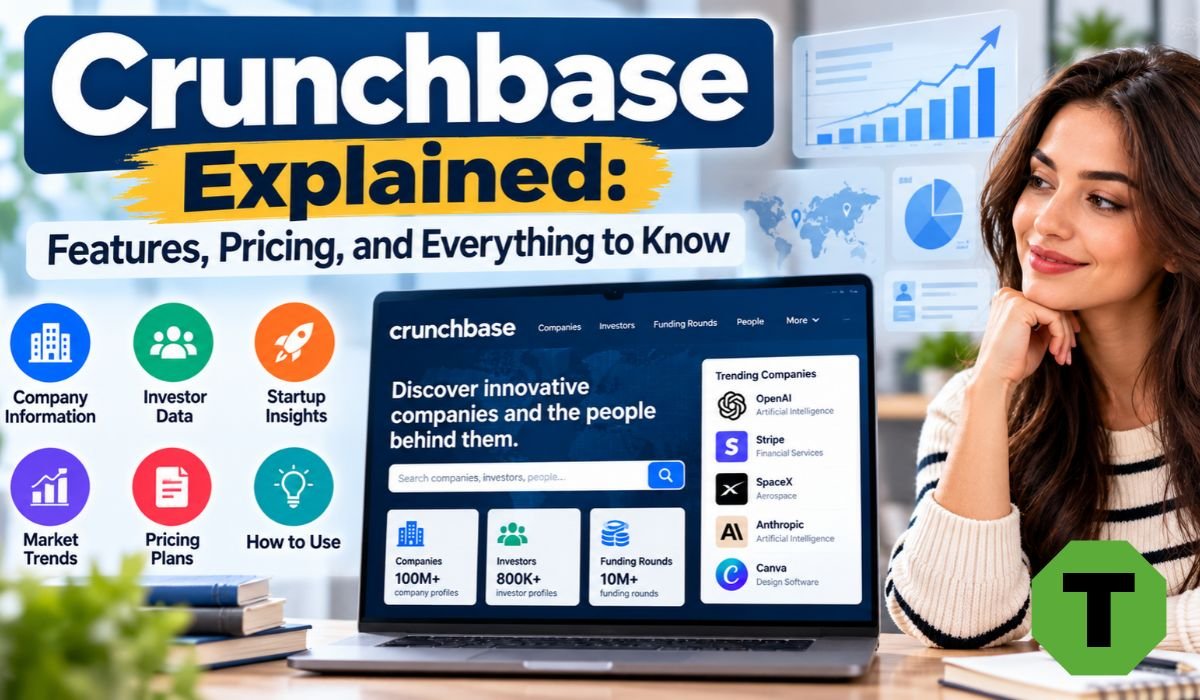
Finding reliable information about startups, investors, and growing companies can be challenging. Business details are often scattered across websites, news articles, and company announcements. Crunchbase brings much of this information together, making business research easier for entrepreneurs, investors, sales professionals, and curious readers.
Crunchbase is a business intelligence platform known for its extensive company database, startup funding information, investor profiles, and research tools. Whether you’re exploring investment opportunities, studying competitors, or searching for potential business partners, the platform can help you understand the companies operating in different industries.
But what exactly does Crunchbase offer, how much does it cost, and is it worth using in 2026? This guide explains its history, features, pricing, benefits, limitations, and practical uses in simple language.
Quick Bio Information About Crunchbase
| Information | Details |
|---|---|
| Platform Name | Crunchbase |
| Business Type | Private Company |
| Founded | 2007 |
| Founder | Michael Arrington |
| Country of Origin | United States |
| Headquarters | San Francisco, California |
| Original Association | TechCrunch |
| Independent Since | 2015 |
| Industry | Business Intelligence and Company Data |
| Main Purpose | Company Discovery and Business Research |
| Main Database Focus | Private Companies, Startups, and Investors |
| Popular Paid Product | Crunchbase Pro |
| Primary Users | Entrepreneurs, Investors, and Sales Teams |
| Company Information | Founders, Industries, Locations, and Business Details |
| Funding Information | Investment Rounds and Reported Funding Amounts |
| Investor Research | Investment Firms and Funding Activity |
| Sales Applications | Lead Discovery and Prospect Research |
| Free Access | Limited Features Available |
| Paid Access | Subscription-Based Features and Business Solutions |
| Main Competitors | PitchBook, CB Insights, and Dealroom |
What Is Crunchbase?
Crunchbase is an online platform that provides information about companies, investors, founders, and business activity. It is especially useful for researching private companies, which often publish less financial information than businesses listed on stock exchanges. Users can explore company backgrounds, funding histories, leadership teams, and investment relationships from one place.
Unlike a regular business directory, Crunchbase connects company information with funding events and market developments. For example, someone researching an artificial intelligence startup may discover its founders, reported investment rounds, and participating venture capital firms. This makes Crunchbase useful for understanding both individual companies and broader industries.
History and Evolution of Crunchbase
Crunchbase began in 2007 as a database associated with TechCrunch, the technology publication founded by Michael Arrington. Its original purpose was to organize information about startups appearing in technology news. As interest in startup investment increased, the database became valuable to people beyond TechCrunch’s readership.
Following AOL’s acquisition of TechCrunch in 2010, Crunchbase continued developing before becoming an independent company in 2015. Its services gradually expanded from basic company profiles into advanced research, commercial intelligence, and business discovery tools.
By 2026, Crunchbase had moved further into predictive intelligence, using artificial intelligence to help users evaluate potential company growth, future funding activity, and other business developments.
How Does Crunchbase Work?
Crunchbase works by collecting, organizing, and presenting business information in searchable company and investor profiles. Users can enter a company name, explore its record, and examine details such as its industry, headquarters, founders, funding history, and related organizations.
The platform obtains information through multiple channels, including public sources, community contributions, business partners, automated data collection, and analyst review. Its database is continually updated, although individual records may not always reflect the latest developments.
Crunchbase also provides search filters and research tools that help users narrow large collections of companies into more useful results. Instead of searching separately for every business, a user can identify organizations that match particular industries, locations, or funding characteristics.
Key Features of Crunchbase
One of Crunchbase’s most useful features is its company database. Profiles bring together important business details, making it easier to understand what an organization does and how it has developed. Funding histories can show reported investment amounts, participating investors, and the timing of previous financing rounds.
Advanced search tools allow users to discover businesses matching specific research requirements. Saved lists, company activity alerts, and research organization features can make repeated investigations more manageable.
A significant development is Crunchbase Scout, an AI-powered research assistant that supports natural-language questions about companies. Crunchbase also offers predictive information about possible funding rounds, acquisitions, growth, and public listings.
These predictions are estimates generated from available signals, not guaranteed future events. They are most valuable when combined with independent research and professional judgment.
Crunchbase Pricing and Subscription Plans
Crunchbase offers free access alongside paid subscriptions designed for individuals and business teams. The free version is suitable for basic company research, while paid services provide more extensive search results, research tools, and workflow capabilities.
Crunchbase Pro is designed for individuals who regularly research companies or discover business opportunities. An official support article lists its monthly subscription at $99, while an annual checkout page has displayed a promotional rate of $49 per seat per month, billed annually, compared with a displayed $79 annual-plan rate. These figures can vary with promotions and billing arrangements, so users should confirm the final checkout price.
Crunchbase Business serves teams requiring broader collaboration, integrations, and company intelligence. The Crunchbase API is intended for organizations integrating data into their own systems. Business and API pricing generally requires contacting the sales team.
How to Use Crunchbase
Getting started with Crunchbase is relatively straightforward. Users can create an account, explore the search interface, and look for companies they want to research. A company profile provides a starting point for understanding its operations, industry, leadership, and available financial history.
Someone researching renewable energy startups, for example, could search for companies in that industry and refine the results using available filters. They could then examine individual profiles to compare business models, locations, and funding activity.
Paid users may have access to more detailed search results, saved research, alerts, and exports. A useful approach is to begin with a clear research question rather than browsing without a specific goal. This makes the platform easier to navigate and the findings more relevant.
Creating and Updating a Crunchbase Profile
Businesses can benefit from maintaining accurate Crunchbase profiles, particularly when potential investors, partners, or customers are researching them. A useful company profile typically includes its official name, description, headquarters, founding date, industry categories, founders, and relevant funding information.
According to Crunchbase’s guidance, registered users who complete the required authentication can create and edit profiles. Users should first search for an existing profile to avoid creating duplicates. Some fields may require verified employment, while certain historical records can only be removed by Crunchbase staff.
Keeping information accurate is more important than making a company appear larger or more successful. Unsupported funding claims, incorrect leadership details, and exaggerated descriptions can mislead readers and damage credibility.
How Crunchbase Helps Startups
For startup founders, Crunchbase can be a useful research tool during fundraising and business planning. Entrepreneurs can study companies in similar industries, examine previous funding rounds, and identify investment firms that have supported comparable businesses.
Imagine a founder developing software for healthcare organizations. Researching other healthcare technology companies may reveal which investors have previously funded businesses in that sector. This information can help the founder build a more focused list of potential investors.
Crunchbase can also support competitor analysis and market understanding. However, appearing in its database does not automatically attract investment, guarantee business exposure, or establish that a company is financially successful.
Crunchbase for Investors and Market Research
Investors use Crunchbase to explore emerging businesses, identify investment activity, and understand relationships between companies and venture capital firms. Its searchable database can help reduce the time required to discover businesses operating in a particular market.
Funding records may reveal whether a company has previously raised capital, which investors participated, and how its financing developed over time. Predictive tools can provide additional signals about possible future activity.
However, Crunchbase is not a substitute for financial due diligence. Reported funding does not prove profitability, strong cash flow, or a sustainable business model. Serious investment decisions require independent verification, financial analysis, management assessment, and consideration of market risks.
Crunchbase for Sales and Marketing
Crunchbase is also useful for business-to-business sales teams searching for potential customers. Instead of approaching companies randomly, professionals can identify businesses that match their preferred industries, locations, and growth characteristics.
For example, a software company selling financial management tools might research recently funded businesses that could need more advanced accounting systems. Funding announcements may suggest changing business requirements, although they do not prove that a company is ready to purchase a particular product.
Marketing teams can use similar research to understand competitors, identify emerging industries, and refine audience targeting. Crunchbase Business also supports selected integrations and data workflows that can help teams organize their research alongside existing customer relationship management systems.
Crunchbase vs. LinkedIn
Crunchbase and LinkedIn both contain business information, but their main purposes differ. Crunchbase focuses on company intelligence, funding records, investor research, and business discovery. LinkedIn primarily supports professional networking, employment opportunities, recruitment, and communication between professionals.
Someone researching a startup’s investment history may find Crunchbase more relevant. Someone looking to connect with its employees or explore job opportunities may prefer LinkedIn.
The platforms can also complement each other. A sales professional might identify a promising company through Crunchbase and then use LinkedIn to research its team. Rather than treating Crunchbase as a direct replacement for LinkedIn, it is more accurate to understand their different strengths.
Advantages and Limitations of Crunchbase
Crunchbase’s main advantage is convenience. It brings company information, investment activity, and business research tools into one environment. Its search features can save time, while funding records and company profiles provide helpful starting points for understanding unfamiliar organizations.
However, its usefulness depends on the quality and completeness of the available information. Smaller businesses may have limited records, and some funding announcements or leadership changes may not appear immediately.
Subscription restrictions are another consideration. Occasional users may not need advanced paid features, while professional researchers may find them valuable. AI-generated predictions also require caution because business outcomes depend on circumstances that cannot always be predicted accurately.
Best Crunchbase Alternatives
Several business research platforms provide alternatives to Crunchbase. PitchBook is widely associated with private-market research, investment information, and financial analysis. CB Insights focuses on business intelligence, market developments, and emerging technologies.
Dealroom is another option for researching startups, investment ecosystems, and technology companies. LinkedIn offers a different approach, emphasizing professional relationships, company pages, and employment information.
The best choice depends on the research objective. A venture capital professional may need detailed investment intelligence, while a small business owner may only require basic company information. Comparing coverage, accessibility, research features, and subscription costs is more useful than assuming one platform suits everyone.
Is Crunchbase Worth Using in 2026?
Crunchbase can be worthwhile for anyone who regularly researches private companies, startup funding, or potential business opportunities. Its combination of company records, search tools, and predictive intelligence provides capabilities beyond a traditional business directory.
For beginners, the free version offers a practical starting point. Professionals conducting frequent research may benefit from Crunchbase Pro, while larger organizations may need team features or API access.
The best way to evaluate its value is to consider how often its information will support meaningful decisions. Crunchbase is most useful when it saves research time, helps identify relevant companies, and provides information that users can independently verify.
Final Thoughts
Crunchbase has evolved considerably since its early days as a startup database. In 2026, it combines company information, investment research, business discovery, and AI-powered intelligence within a single platform.
Its greatest strength is helping users understand companies and identify opportunities more efficiently. Whether you’re a startup founder, investor, entrepreneur, or sales professional, Crunchbase can provide useful context for business decisions.
Still, no database can replace careful research. Used alongside reliable primary information and sound judgment, Crunchbase can be a valuable part of a modern business research workflow.
Learn more and explore exciting content on: Direct Express Explained: Card Activation, Login, Benefits, and More
 Backlinks Hub
[…] Learn more and explore exciting content on: Crunchbase Explained: Features, Pricing, and Everything to Know […]