
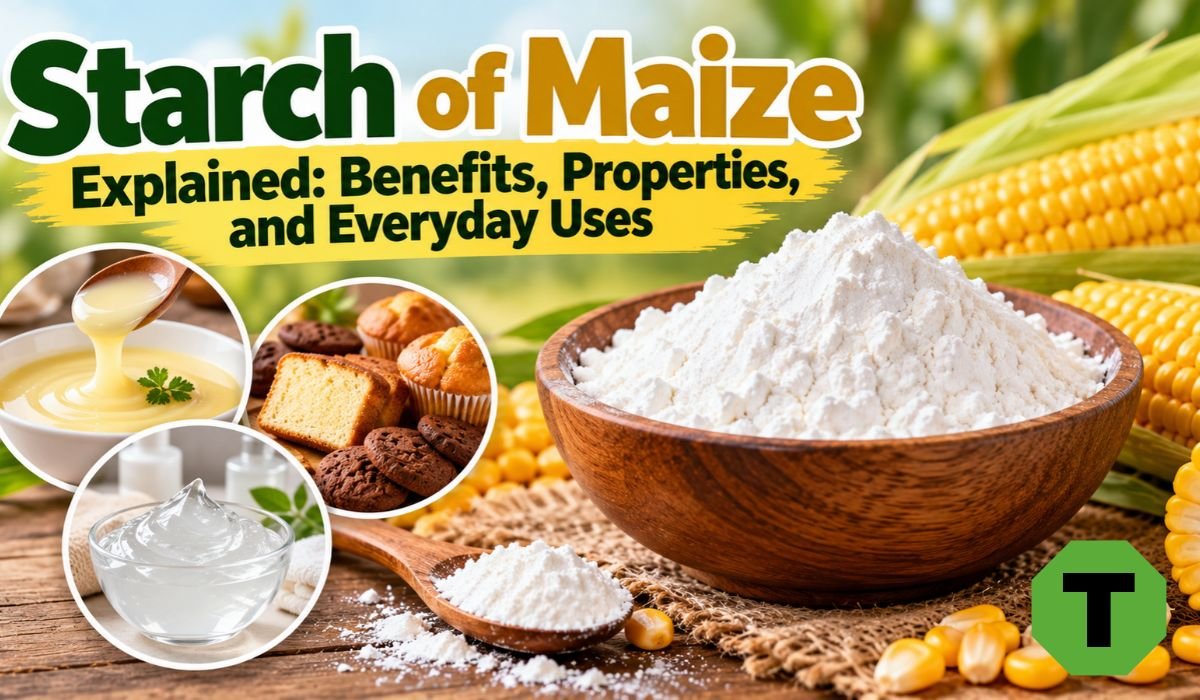
Have you ever wondered what makes your favorite gravy thick, your pudding smooth, or your fried chicken wonderfully crispy? The answer may be a simple ingredient sitting in your kitchen cupboard: Starch of Maize.
Also known as cornstarch, this fine white powder comes from corn kernels and plays an important role in cooking, food manufacturing, and several other industries. Its ability to absorb water, thicken liquids, and improve texture makes it one of the most useful ingredients in everyday food preparation.
However, maize starch offers much more than kitchen convenience. It is also used in medicines, paper products, textiles, and specialized packaging materials.
Understanding its properties, nutritional value, benefits, and limitations can help you make better choices when cooking or selecting food products.
Quick Information About Starch of Maize
| Information | Details |
|---|---|
| Common Name | Maize Starch |
| Alternative Name | Cornstarch |
| Scientific Source | Zea mays |
| Plant Family | Poaceae |
| Main Source | Corn Kernel Endosperm |
| Appearance | Fine White Powder |
| Taste | Neutral |
| Smell | Generally Odorless |
| Main Nutrient | Carbohydrates |
| Main Components | Amylose And Amylopectin |
| Primary Function | Thickening And Texture Improvement |
| Common Production Method | Wet Milling |
| Gluten Content | Naturally Gluten-Free When Pure |
| Common Food Uses | Sauces, Soups, Desserts, And Coatings |
| Industrial Applications | Paper, Textiles, Medicines, And Adhesives |
| Main Types | Native, Modified, Waxy, And High-Amylose |
| Storage Method | Cool, Dry, Airtight Container |
| Nutritional Character | Refined Carbohydrate Source |
What Is Starch of Maize?
Starch of Maize is a refined carbohydrate extracted mainly from the endosperm of corn kernels. The endosperm is the part of the grain that stores energy for the developing plant.
After processing, the starch becomes a soft, white powder with little flavor or smell. When mixed with water and heated, it thickens liquids and helps create smooth textures.
In the United States, this ingredient is commonly called cornstarch. In the United Kingdom, the term cornflour often refers to the same product.
Although maize starch and maize flour come from corn, they are different ingredients. Maize flour contains more of the original grain components, while maize starch is primarily purified starch.
Where Does Maize Starch Come From?
Maize starch comes from corn, scientifically known as Zea mays. Corn is cultivated worldwide and serves as an important crop for food, animal feed, and industrial manufacturing.
A corn kernel contains several parts, including the outer covering, germ, and endosperm. The endosperm contains most of the starch, making it the main source for commercial extraction.
Manufacturers generally use corn varieties selected for their starch content and processing performance.
Corn is an agricultural raw material that can be grown repeatedly, although its environmental impact depends on farming methods, water availability, and processing practices.
How Is Starch of Maize Produced?
Commercial maize starch is commonly produced through a process called wet milling. This method separates starch from the other components of corn kernels.
First, manufacturers clean the harvested corn to remove dirt and unwanted materials. The kernels are then soaked under controlled conditions to soften them and make separation easier.
Next, the softened corn is ground. The germ is separated and may be processed into corn oil. Additional steps remove fiber and protein from the starch-rich mixture.
The starch is washed, purified, concentrated, and dried into a fine powder.
Food-grade maize starch must meet relevant quality and safety requirements. Manufacturers monitor factors such as purity, moisture, and consistency to ensure reliable performance.
Chemical Composition And Properties Of Maize Starch
The special properties of maize starch come mainly from two carbohydrate molecules called amylose and amylopectin.
Amylose has a mostly linear structure, while amylopectin has a branched structure. Their proportions influence how starch thickens, forms gels, and changes during cooling.
When maize starch is heated with sufficient water, its granules absorb moisture and swell. This process is called gelatinization, and it creates the thickness needed for sauces, custards, and gravies.
After cooling, some starch molecules gradually reorganize through a process called retrogradation. This can change firmness and sometimes cause water separation.
Temperature, acidity, sugar, and processing conditions can all affect starch performance.
Different Types Of Maize Starch
Not every maize starch product behaves in the same way. Manufacturers produce different varieties for specific cooking and industrial requirements.
Native maize starch is extracted and purified without deliberate chemical modification. It is commonly used for thickening and binding.
Modified maize starch undergoes physical, enzymatic, or chemical treatment to improve selected properties, such as resistance to heat, acidity, or freezing. Modified starch does not automatically mean genetically modified corn.
Waxy maize starch contains predominantly amylopectin and is useful where particular texture characteristics are needed.
High-amylose maize starch contains more amylose than ordinary varieties. Some specially processed forms provide resistant starch and are used in specialized food products.
Nutritional Value Of Starch Of Maize
Maize starch is primarily a carbohydrate source. It provides energy but contains relatively little protein, fat, fiber, or essential micronutrients.
Its exact nutritional values depend on the product, but ordinary dry cornstarch typically provides approximately 380 calories and 91 grams of carbohydrates per 100 grams.
Because it is highly refined, maize starch does not offer the same nutritional variety as whole corn or whole grains.
Most people use small amounts in recipes rather than eating large quantities directly. Its nutritional contribution therefore depends on the serving size and the complete meal.
For a balanced diet, maize starch is best treated as a functional cooking ingredient rather than a major source of vitamins or minerals.
Benefits Of Starch Of Maize
One of the biggest benefits of Starch of Maize is its ability to improve food consistency without introducing a strong flavor.
It can turn thin liquids into smooth sauces, help desserts develop a creamy texture, and contribute to crispy coatings on fried foods.
Pure maize starch is naturally gluten-free, making it useful in suitable gluten-free recipes. However, people with coeliac disease should choose products with reliable gluten-free labeling.
Another advantage is its versatility. Small quantities can perform important functions in cooking, while specialized grades support manufacturing applications.
Maize starch also provides digestible carbohydrates for energy. Nevertheless, these practical benefits should not be confused with claims that it is a nutrient-rich health food.
Is Starch Of Maize Healthy?
Maize starch can be included in a balanced diet, but its health effects depend on the quantity consumed and the foods eaten alongside it.
Ordinary cooked maize starch is generally digested into glucose, which can influence blood sugar levels. People managing diabetes or monitoring carbohydrates should consider how much starch their meals contain.
Maize starch also contains very little dietary fiber. It should not replace vegetables, legumes, or whole grains as a regular source of nutrition.
Certain high-amylose starch products contain resistant starch, which is less readily digested in the small intestine and may be fermented in the large intestine.
However, ordinary cornstarch should not automatically be considered a significant source of resistant starch.
Everyday Uses Of Maize Starch In Cooking
Maize starch is especially popular because it improves texture while allowing the original flavors of food to remain noticeable.
In soups, sauces, and gravies, it creates a thicker consistency. In puddings, custards, and fruit fillings, it helps ingredients form a smooth mixture.
Bakers sometimes use maize starch to adjust tenderness in cakes, cookies, and selected flour blends. However, it cannot independently provide the elastic structure needed for traditional wheat bread.
For frying, maize starch can help create a light, crisp coating on chicken, vegetables, and other foods.
Its usefulness extends to stir-fry sauces and many prepared foods where consistency and texture are important.
How To Use Maize Starch Correctly
Using maize starch correctly makes a noticeable difference in cooking results.
The easiest method is to prepare a slurry by mixing the starch with a small amount of cold water. Once smooth, gradually add the mixture to a hot liquid while stirring.
For a lightly thickened sauce, approximately one tablespoon of cornstarch per cup of liquid can be a useful starting point. The exact amount depends on the recipe.
Continue heating until the starch thickens the mixture. Avoid unnecessary prolonged boiling, which may weaken the texture in some preparations.
Adding dry starch directly to hot liquid can create lumps. Mixing it with cold water first helps achieve a smoother result.
Industrial Applications Of Maize Starch
Beyond the kitchen, maize starch is an important ingredient in several industries.
In paper manufacturing, starch-based formulations improve surface properties, strength, and printability. Textile manufacturers use starch in selected yarn-sizing and fabric-finishing processes.
Pharmaceutical manufacturers may use suitable grades of maize starch in tablets to help ingredients bind together or allow tablets to break apart after administration.
Starch-derived materials are also used in adhesives for cardboard and packaging.
Researchers continue exploring starch-based films and packaging materials. However, whether these materials offer environmental advantages depends on their composition, manufacturing process, and disposal conditions.
Maize Starch Vs. Maize Flour And Other Starches
Maize starch and maize flour are often confused, but they have different compositions and purposes.
Maize starch is mainly purified starch and is commonly used for thickening. Whole maize flour contains more of the grain’s original components and may provide additional protein, fiber, and nutrients.
Potato starch, tapioca starch, and arrowroot powder can sometimes replace maize starch in recipes. However, their thickening behavior, texture, and heat tolerance differ.
Potato starch is useful in many thickening and coating applications, while tapioca starch can create a glossy or slightly elastic texture.
Choosing the right substitute depends on whether you are preparing a sauce, dessert, baked product, or fried coating.
Storage, Quality, And Sustainability
Proper storage helps maize starch maintain its quality.
Keep the powder in a tightly sealed container in a cool, dry place away from moisture and strong odors. Exposure to humidity can cause clumping and may encourage contamination.
Discard starch that develops unusual odors, visible contamination, or signs of moisture damage. Always follow the manufacturer’s storage instructions.
From an environmental perspective, maize starch comes from a renewable crop, but production still requires agricultural land, water, and energy.
Responsible farming, efficient processing, and careful waste management can help improve sustainability.
Final Thoughts
Starch of Maize is a simple ingredient with an impressive range of applications. From thickening homemade gravy to supporting paper manufacturing and pharmaceutical production, its usefulness extends far beyond the kitchen.
Its neutral flavor, thickening ability, and versatility make it valuable for everyday cooking. At the same time, understanding its refined carbohydrate content and nutritional limitations helps consumers make informed dietary choices.
Whether you are preparing desserts, exploring gluten-free cooking, or learning about food ingredients, knowing how maize starch works can help you use it more effectively.
FAQs About Starch Of Maize
What Is Starch Of Maize Used For?
Starch of Maize is mainly used to thicken soups, sauces, gravies, and desserts. It also improves certain baked goods and fried coatings. Industrial applications include paper manufacturing, pharmaceuticals, textiles, and adhesives.
Is Maize Starch The Same As Cornstarch?
Yes. Maize starch and cornstarch generally refer to the same refined ingredient extracted from corn kernels. Regional naming differences can cause confusion, particularly with the terms cornflour and maize flour.
Is Starch Of Maize Good For Health?
Maize starch can fit into a balanced diet, but it mainly provides carbohydrates. It contains little fiber, protein, or essential micronutrients. Portion size and overall dietary quality are important.
Is Maize Starch Gluten-Free?
Pure maize starch is naturally gluten-free. However, cross-contact with gluten-containing grains may occur during manufacturing. People with coeliac disease should choose appropriately labeled gluten-free products.
Can Maize Starch Replace Wheat Flour?
Maize starch can replace wheat flour for some thickening purposes, but it is not a direct substitute in every baking recipe. It lacks gluten and cannot provide the same structure as wheat flour.
Does Maize Starch Affect Blood Sugar?
Yes. Ordinary digestible maize starch can increase blood glucose because it is broken down into glucose during digestion. The effect depends on the quantity consumed, preparation, and overall meal composition.
What Is The Best Substitute For Maize Starch?
Potato starch, tapioca starch, and arrowroot powder are common alternatives. Wheat flour can also work for certain sauces if gluten is acceptable. The best choice depends on the recipe and desired texture.
How Long Can Maize Starch Be Stored?
Dry maize starch can maintain its quality for a long time when properly sealed and protected from moisture. Its usable storage period depends on packaging and conditions. Follow the manufacturer’s date guidance and discard any product showing contamination or moisture damage.
Learn more and explore exciting content on: Viltnemnda Explained: How Norway Manages Wildlife and Hunting
[…] Learn more and explore exciting content on: Starch of Maize Explained: Benefits, Properties, and Everyday Uses […]