
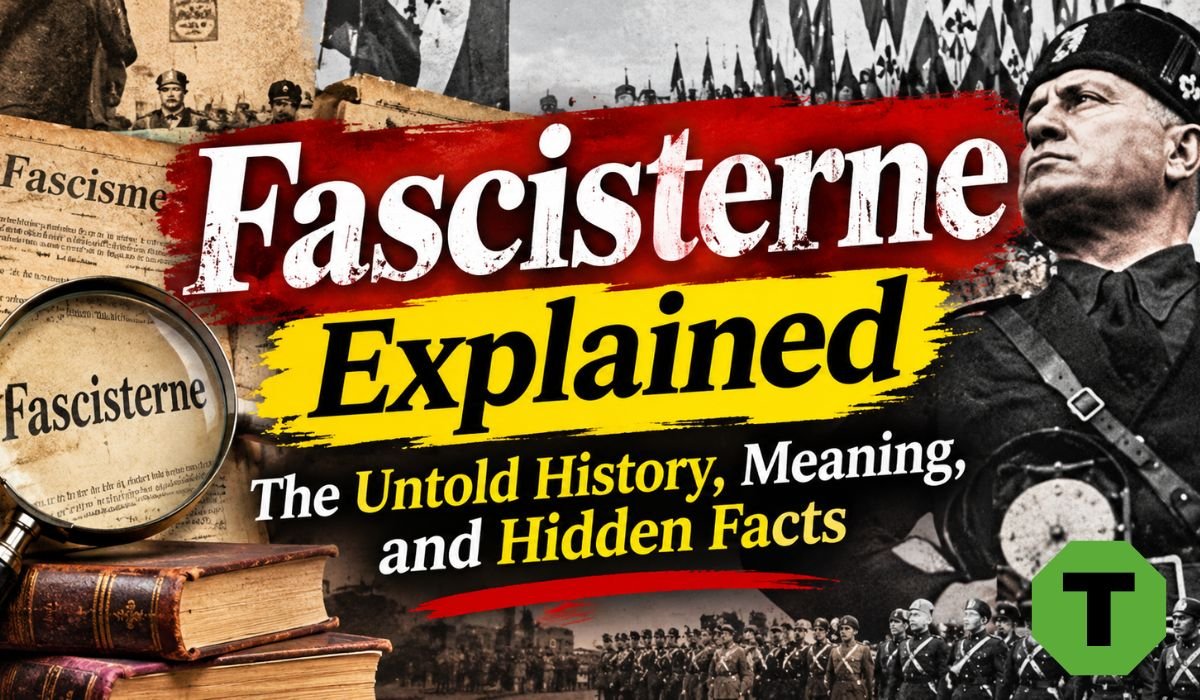
The word Fascisterne may seem unfamiliar, but its meaning connects to one of the most important and troubling chapters in European history. This Danish term translates to “the fascists” and describes people associated with fascist political movements. These movements influenced governments, challenged democratic institutions, and contributed to the political tensions surrounding World War II.
Fascism became especially powerful in Italy under Benito Mussolini, while Germany experienced the rise of Adolf Hitler and National Socialism. However, similar political movements also appeared in smaller European countries, including Denmark. Their experiences reveal how extremist ideas spread, why some movements gained power, and why others failed.
Understanding Fascisterne means exploring more than political leaders and historical events. It involves examining nationalism, propaganda, dictatorship, resistance, and the importance of democratic institutions. This guide explores the meaning, origins, history, ideology, and lesser-known facts about Fascisterne, along with its continuing relevance in 2026.
Quick Bio Information About Fascisterne
| Information | Details |
|---|---|
| Main Term | Fascisterne |
| English Meaning | The Fascists |
| Original Language | Danish |
| Word Category | Definite Plural Noun |
| Associated Ideology | Fascism |
| Historical Period | Twentieth Century |
| Political Origins | Post-World War I Europe |
| Birthplace of Organized Fascism | Italy |
| Major Italian Leader | Benito Mussolini |
| Major German Nazi Leader | Adolf Hitler |
| Important Danish Organization | DNSAP |
| DNSAP Founder | Cay Lembcke |
| DNSAP Founding Year | 1930 |
| Prominent Danish Nazi Leader | Frits Clausen |
| German Invasion of Denmark | April 9, 1940 |
| Danish Liberation | May 1945 |
| Main Political Characteristics | Authoritarianism and Ultranationalism |
| Historical Importance | European Politics and World War II |
| Modern Relevance | Democratic History and Political Awareness |
What Does Fascisterne Mean?
Fascisterne is a Danish word meaning “the fascists” in English. It is the definite plural form of fascist, referring to a particular group of people associated with fascist ideology. The term itself is not the official name of a political party or organization.
In historical writing, Fascisterne may describe supporters of fascist movements in Denmark or elsewhere in Europe. Its meaning depends on the context in which it appears. Understanding the difference between fascists and fascism is also important. Fascists are individuals who support the ideology, while fascism describes the broader political beliefs and practices associated with these movements.
The Linguistic Origins of Fascisterne
The word Fascisterne comes from Danish grammar, where the ending -erne helps form a definite plural expression. This explains why the word refers to “the fascists” rather than simply “fascists.”
The broader term fascism has Italian roots. It is connected to fascio, meaning a bundle or group, and to the ancient Roman fasces, a symbol consisting of bound rods associated with authority.
Mussolini’s movement adopted this historical symbolism to communicate unity and political strength. Over time, fascism became associated with authoritarian nationalism and the rejection of liberal democracy.
The Historical Background Behind Fascisterne
The history of Fascisterne is closely connected to Europe’s political instability following World War I. Many countries experienced economic hardship, unemployment, social unrest, and disappointment with established governments.
These difficulties created opportunities for extremist political movements. Fascist leaders promised stability, national renewal, and strong leadership. They often argued that democratic institutions were too weak to solve national problems.
However, economic hardship alone does not explain fascism’s rise. Political violence, nationalist resentment, fear of communism, and decisions made by established political elites also influenced its development.
Understanding these conditions helps explain why fascist movements attracted supporters in some countries while remaining politically marginal in others.
How Fascism First Emerged in Europe
Organized fascism developed in Italy after World War I. Benito Mussolini established his Fascist movement in 1919, attracting supporters through nationalism, political intimidation, and promises of restoring Italian strength.
In October 1922, the March on Rome helped pressure Italy’s political leadership, and King Victor Emmanuel III appointed Mussolini prime minister. Mussolini gradually dismantled democratic institutions and established a dictatorship.
The Italian example influenced extremist nationalist organizations elsewhere in Europe. Germany developed National Socialism, while smaller movements emerged in countries including Denmark.
The Great Depression later intensified political instability, although the success of fascist organizations varied considerably between countries.
The Political Ideology and Core Beliefs of Fascisterne
Historical fascist movements generally promoted ultranationalism, authoritarian leadership, militarism, and opposition to pluralist democracy. They presented the nation as more important than individual political freedoms and demanded loyalty to powerful leaders.
Fascist organizations frequently used uniforms, marches, symbols, and public demonstrations to project discipline and unity. Political opponents were often portrayed as enemies of national progress.
Propaganda and censorship became important tools for controlling public opinion. In countries where fascists established dictatorships, independent journalism and political competition faced severe restrictions.
Although fascist movements shared important characteristics, their specific policies differed. Historians therefore examine each movement’s ideology and historical circumstances rather than treating every authoritarian government as fascist.
Benito Mussolini and the Rise of Italian Fascism
Benito Mussolini played a central role in transforming fascism into an organized political movement. After becoming Italian prime minister in 1922, he gradually concentrated political authority and weakened parliamentary institutions.
His government restricted opposition parties, limited press freedom, and used political intimidation to maintain control. Mussolini promoted militarism and argued that Italy needed territorial expansion to restore its international importance.
Italy’s invasion of Ethiopia in 1935 demonstrated the regime’s imperial ambitions and caused widespread suffering.
Mussolini’s dictatorship collapsed in 1943, although he later headed a German-supported fascist regime in northern Italy until 1945. His political methods influenced authoritarian movements across Europe.
Adolf Hitler and the Development of Nazism
Adolf Hitler became German chancellor in January 1933 after years of political instability and growing Nazi electoral support. His government rapidly dismantled democratic safeguards and established a dictatorship.
Nazism shared characteristics with Italian Fascism, including extreme nationalism, militarism, propaganda, and political repression. However, Nazi ideology placed racial hierarchy and antisemitism at its center.
The Nazi regime organized the Holocaust, systematically murdering approximately six million European Jews. Millions of other people also suffered persecution and mass killing under Nazi policies.
These crimes demonstrate the devastating consequences of Nazi racial ideology, state violence, and the destruction of fundamental human rights.
Fascism vs. Nazism: Understanding the Key Differences
Fascism and Nazism are closely related historical ideologies, but they are not identical. Italian Fascism initially emphasized national unity, centralized authority, military strength, and the restoration of Italian power.
German Nazism combined authoritarian nationalism with a central commitment to racial hierarchy, antisemitism, and territorial conquest.
Both systems rejected liberal democracy and suppressed political opposition. Both also relied heavily on propaganda, censorship, and state violence.
Italian Fascism later adopted explicitly antisemitic racial laws in 1938. Recognizing these developments helps explain both the similarities and important differences between the movements.
The Untold History of Fascisterne in Denmark
Denmark experienced the influence of European fascism during the years between the world wars. Several extremist nationalist organizations emerged, but none achieved the political dominance seen in Italy or Germany.
The most prominent Danish Nazi organization was Danmarks Nationalsocialistiske Arbejderparti, commonly called DNSAP.
Denmark’s established parliamentary parties continued to attract broad public support, limiting the electoral success of extremist movements.
The Danish experience is particularly interesting because it demonstrates that exposure to fascist ideas did not automatically produce a fascist government. Political institutions, public attitudes, and national circumstances shaped the outcome.
DNSAP and the Rise of Danish National Socialism
Cay Lembcke founded DNSAP on November 16, 1930. The party adopted ideas and organizational methods inspired by German National Socialism.
Frits Clausen became its leader in 1933 and attempted to expand its political influence through campaigning, propaganda, and public activities.
DNSAP promoted authoritarian nationalism, antisemitism, and opposition to parliamentary democracy. Despite its ambitions, the party struggled to gain widespread electoral support.
In Denmark’s March 1943 parliamentary election, DNSAP received approximately 2.1 percent of the vote and secured three seats. It never became Denmark’s ruling party.
Why Fascisterne Failed to Gain Political Power in Denmark
Danish fascist and Nazi organizations faced several obstacles that limited their political success. Established parliamentary parties retained strong support, and extremist movements struggled to convince voters that dictatorship offered a better alternative.
DNSAP also faced a significant contradiction. It promoted Danish nationalism while closely following a German political movement whose expansion threatened Danish independence.
Germany’s occupation of Denmark did not resolve this problem. Even with ideological connections to Nazi Germany, DNSAP failed to establish national political control.
Its limited success illustrates how political traditions, public opinion, and institutional conditions can influence the development of extremist movements.
Fascisterne During World War II
Germany invaded Denmark on April 9, 1940, bringing the country under occupation. The invasion created new opportunities for Danish Nazi organizations to seek political influence.
DNSAP hoped its ideological connection with Germany would help it gain governmental authority. However, German occupation officials did not install the party as Denmark’s national government.
Some Danish Nazis collaborated with German authorities and supported recruitment for German military service.
Meanwhile, opposition to the occupation gradually expanded. The occupation period revealed deep divisions between collaboration, accommodation, and resistance within Danish society.
Danish Resistance Against Fascism and Nazi Occupation
The Danish resistance movement became an important part of the country’s wartime history. Resistance groups produced underground newspapers, collected intelligence, organized sabotage, and assisted people threatened by Nazi persecution.
One particularly significant event occurred in October 1943, when thousands of Danish Jews escaped to neutral Sweden with help from Danish citizens and resistance networks.
The rescue demonstrated the importance of cooperation and civilian action during persecution.
Denmark’s wartime history also involved difficult choices and changing political circumstances. Understanding both collaboration and resistance provides a more complete picture of the occupation.
How Fascisterne Used Propaganda and Political Symbols
Propaganda played an important role in historical fascist movements. Political organizations used newspapers, radio broadcasts, posters, speeches, uniforms, and rallies to spread their messages.
These methods helped leaders present themselves as powerful figures capable of restoring national strength. Propaganda often blamed political opponents, minorities, or foreign influences for complicated social problems.
In fascist dictatorships, censorship restricted access to competing information and made it difficult for citizens to challenge official claims.
Studying these historical methods highlights the importance of independent journalism, reliable evidence, and critical thinking when evaluating political messages.
Hidden Facts About Fascisterne That Many People Do Not Know
One frequently overlooked fact is that Fascisterne is a Danish grammatical expression, not the official name of a historical organization. The word can refer to different groups depending on the context.
Another important detail is that Denmark’s Nazi party remained politically marginal even during German occupation.
The Danish experience also challenges the assumption that fascism spread uniformly across Europe. Some countries developed dictatorships, while others retained parliamentary systems despite the presence of extremist organizations.
These differences demonstrate why national historical context matters when studying political movements.
Common Myths and Misconceptions About Fascisterne
A common misunderstanding is that fascism and nationalism mean the same thing. Nationalism can take many political forms, while historical fascism combined ultranationalism with authoritarian leadership, political repression, and opposition to pluralist democracy.
Another misconception is that every authoritarian government is fascist. Historians distinguish between different political systems by examining their ideology, institutions, and practices.
It is also incorrect to assume that all European fascist movements achieved political power.
Denmark provides a clear example of a country where extremist organizations existed without establishing a national fascist dictatorship.
Why Fascisterne Still Matters in Modern Society
Understanding Fascisterne remains valuable in 2026 because historical fascist movements reveal how political institutions can weaken under pressure.
Their history demonstrates the dangers of political intimidation, discrimination, propaganda, and concentrated authority.
However, modern political movements should not automatically be compared with historical fascism. Meaningful comparisons require careful evidence and an understanding of different political circumstances.
The Danish experience also offers insight into how democratic institutions and public support can limit extremist political influence.
Studying this history encourages informed discussion, historical accuracy, and awareness of fundamental rights.
FAQs About Fascisterne
What Does Fascisterne Mean in English?
Fascisterne means “the fascists” in Danish. It refers collectively to people associated with fascist political ideology. The word can describe historical activists, supporters, or organizations depending on the context.
Where Did Fascisterne Originate?
Fascisterne is a Danish word. The political ideology associated with it developed primarily in Europe after World War I, with organized Fascism emerging in Italy under Benito Mussolini.
Is Fascisterne a Political Party?
No. Fascisterne is a general Danish expression rather than the official name of a political party. It can refer to individuals or groups connected with fascist movements.
Who Were the Fascisterne in Denmark?
The term can describe Danish supporters of fascist or Nazi ideology. One important historical organization was DNSAP, founded by Cay Lembcke in 1930 and later led by Frits Clausen.
Did Fascisterne Ever Rule Denmark?
No. Danish Nazi organizations never established a national fascist government. DNSAP remained a small political party, including during Germany’s occupation of Denmark.
What Was DNSAP?
DNSAP was the Danish National Socialist Workers’ Party. It adopted ideas inspired by German Nazism and promoted authoritarian nationalism, antisemitism, and opposition to parliamentary democracy.
How Were Fascisterne Connected to World War II?
Some Danish Nazis collaborated with German occupation authorities and supported recruitment for German military service. Other Danish citizens resisted occupation through underground activities and assistance to persecuted people.
Why Is Fascisterne Important Today?
Studying Fascisterne helps readers understand European political history, extremist ideology, propaganda, and authoritarian leadership. It also highlights the historical importance of democratic accountability and human rights.
Final Thoughts
The history of Fascisterne provides an important perspective on the development of fascist movements in twentieth-century Europe. From Mussolini’s dictatorship in Italy to Hitler’s Nazi regime in Germany, these movements had lasting political and human consequences.
Denmark followed a different path. Although extremist organizations attempted to expand their influence, they never achieved national political control.
Understanding Fascisterne therefore involves more than learning a Danish word. It means examining historical circumstances, political ideology, wartime experiences, and the choices societies make when democratic institutions face pressure.
These lessons remain relevant because accurate historical knowledge helps people recognize the complexity of political movements and appreciate the importance of informed public discussion.
Learn more and explore exciting content on: Witelovers Explained: Meaning, Origins, Lifestyle, and Hidden Facts
 Backlinks Hub
[…] Learn more and explore exciting content on: Fascisterne Explained: The Untold History, Meaning, and Hidden Facts […]