
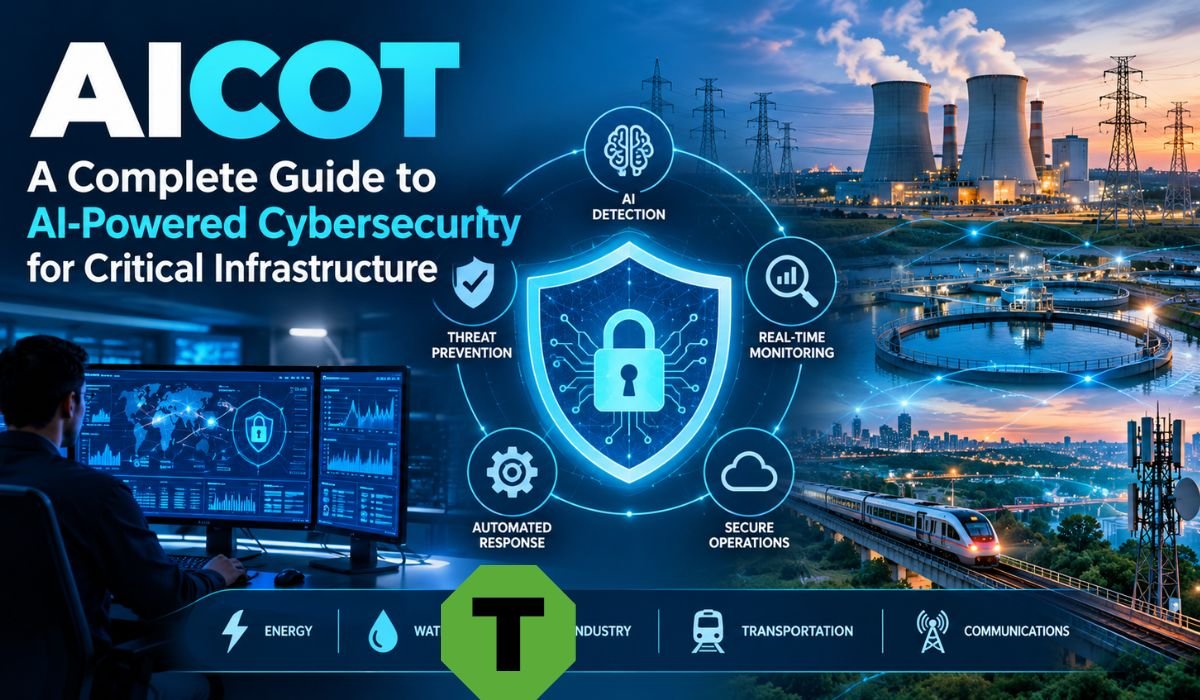
Critical Infrastructure is becoming more connected every year. Energy networks, transportation systems, water facilities, manufacturing plants, and other essential services increasingly depend on digital technologies and Operational Technology (OT). This connectivity brings major benefits, but it also creates new cybersecurity challenges. AICOT is a European research project designed around this problem. Its full name is AI-Driven Cyber Defense Platform for Operational Technology Environments in Critical Infrastructure. The project aims to combine Artificial Intelligence, Machine Learning, Anomaly Detection, OT Protocol Analysis, Threat Intelligence, and Real-Time Monitoring into a specialized cybersecurity platform for industrial environments. It is led by Logstail and builds on the company’s existing SIEM and Data Analytics capabilities.
Quick Bio Information About AICOT
| AICOT Information | Details |
|---|---|
| Project Name | AI-Driven Cyber Defense Platform for Operational Technology Environments in Critical Infrastructure |
| Main Focus | OT Cybersecurity And Critical Infrastructure Protection |
| Core Technology | Artificial Intelligence And Machine Learning |
| Detection Approach | Anomaly Detection And Behavioural Analysis |
| Security Focus | Real-Time Monitoring, Detection And Response |
| Main Environment | Operational Technology |
| Target Sectors | Energy, Transport, Water, Manufacturing And Other Critical Infrastructure |
| Protocol Focus | Modbus, DNP3, PROFINET And IEC 61850 |
| Platform Foundation | Logstail SIEM And Data Analytics |
| CTI Focus | Secure And Privacy-Preserving Threat Intelligence Sharing |
| Blockchain Role | Supporting Trust, Privacy, Auditability And Interoperability |
| AI Direction | Proactive Detection Of Stealthy And Previously Unseen Threats |
| Development Model | Modular And Scalable |
| Validation | Realistic OT Pilot Environments |
| Readiness Goal | Technology Readiness Level 7–8 |
| European Objective | Strengthening EU Digital Sovereignty |
| Project Type | Research, Development And Validation |
| Technology Approach | OT-Native AI-Powered Cyber Defense |
What Is AICOT?
AICOT is an EU-focused cybersecurity research project created specifically for Operational Technology Environments in Critical Infrastructure. Rather than treating industrial networks like ordinary office IT networks, the project is designed around the special requirements of systems that monitor and control physical processes. Its stated objectives include building a modular and scalable cybersecurity platform, developing proactive AI-based threat detection, enabling secure CTI sharing, validating the platform in realistic OT scenarios, and supporting European digital sovereignty.
The project builds on Logstail’s existing SIEM and Data Analytics capabilities and is intended to extend them with Machine Learning, Anomaly Detection, OT Protocol Analysis, Threat Intelligence, Real-Time Monitoring, and response capabilities. Importantly, AICOT should be described as a research and development project with planned and developing capabilities, rather than assuming that every proposed feature has already become a widely deployed commercial solution.
Why AICOT Matters For Critical Infrastructure
Critical Infrastructure supports services that societies and economies depend on every day. When the digital systems behind these services are compromised, the consequences can extend beyond stolen information. A cybersecurity incident may interrupt production, affect service availability, interfere with industrial operations, or create safety concerns.
AICOT’s project documentation identifies sectors such as Energy, Transport, Water, and Manufacturing as important OT environments. Many of these environments also rely on legacy equipment and industrial protocols that were not originally designed for today’s highly connected threat landscape. At the same time, OT networks increasingly interact with enterprise IT, cloud platforms, vendors, remote-access services, and other systems. AICOT is designed to address this expanding security boundary through deeper OT visibility and specialized analysis.
Understanding Operational Technology
Operational Technology refers to hardware and software used to monitor or control physical processes. This can include Programmable Logic Controllers, SCADA Systems, Human-Machine Interfaces, Sensors, Industrial Controllers, Engineering Workstations, and Remote Terminal Units.
A PLC, for example, can control machinery or an industrial process. A SCADA system can help operators monitor equipment and processes across a facility. These systems are different from a typical office computer because their activity can influence the physical world.
That distinction is central to AICOT. A security platform for OT needs to understand not only whether network traffic looks unusual, but also what systems are communicating, what role those systems perform, and why a particular activity might matter to the industrial process.
How OT Security Differs From IT Security
IT and OT Cybersecurity share many fundamental goals, but the operational consequences of security actions can be very different. An IT security team may isolate a compromised workstation quickly. In an industrial environment, immediately disconnecting a device could interrupt a production process or affect another system that depends on it.
OT environments can also contain older equipment, specialized protocols, strict uptime requirements, and systems that cannot easily be patched or replaced. This means security teams need operational context when investigating suspicious activity.
AICOT’s approach reflects this difference by focusing on OT-aware monitoring, protocol analysis, behavioural understanding, and context. The goal is not simply to produce more alerts. It is to help security teams understand which activity is unusual, why it matters, and what could potentially be affected.
How AICOT Uses Artificial Intelligence And Machine Learning
Artificial Intelligence and Machine Learning are central to the AICOT concept. The project aims to use these technologies to analyse OT telemetry and recognize patterns that may indicate suspicious activity. AICOT’s objectives also include research into Generative and Adversarial AI for proactive detection of stealthy and previously unseen threats.
However, AI should not be presented as a magic solution capable of identifying every Zero-Day Attack. In an industrial environment, the quality of the data and the context surrounding an event are extremely important. A useful AI system needs to understand relationships between assets, identities, communications, protocols, and normal operational behaviour.
Recent AICOT material emphasizes a model in which AI detection is followed by contextual enrichment, analyst review, OT engineering validation, and controlled response. That approach is particularly important when cybersecurity decisions could affect physical operations.
AICOT And OT Anomaly Detection
Anomaly Detection is particularly useful in OT because industrial systems often have relatively stable communication patterns. A controller may normally communicate with a known set of systems, while an engineering workstation may have predictable relationships with particular industrial assets.
If those patterns suddenly change, the activity may deserve investigation. Yet an anomaly does not automatically mean an attack. Maintenance, equipment replacement, commissioning, production changes, testing, and emergency procedures can all create unusual activity.
AICOT therefore focuses on putting anomalies into context. Its project approach combines Machine Learning and Anomaly Detection with OT Protocol Analysis, Threat Intelligence, and other security information. The goal is to identify meaningful deviations instead of treating every unusual event as malicious. AICOT’s own recent material highlights the importance of asking whether observed behaviour actually makes sense for the specific industrial environment.
AICOT And Industrial Protocol Analysis
Industrial Protocol Analysis is another important part of the project. Protocols such as Modbus, DNP3, PROFINET, and IEC 61850 are associated with different types of industrial environments and equipment. Understanding these communications can provide security teams with information that ordinary IT-focused monitoring may not capture as deeply.
AICOT’s goal is to provide more OT-native visibility by examining industrial communications alongside other security evidence. This can help analysts understand whether a command or communication fits expected behaviour.
For example, a connection involving an Engineering Workstation may appear harmless on its own. If it is followed by communication with a critical controller, a program change, and other unusual activity, the combined sequence becomes much more important. This is where protocol awareness and event correlation can provide additional value.
Real-Time Monitoring And Threat Detection
AICOT is designed around Real-Time Monitoring, Threat Detection, and Response. Modern industrial environments can generate evidence from PLCs, SCADA systems, Engineering Workstations, firewalls, VPN services, identity systems, endpoints, industrial networks, and supporting infrastructure.
Looking at each event separately can make an investigation difficult. A recent AICOT example describes how a remote login, engineering workstation activity, communication with a safety-relevant PLC, a program download, and a subsequent change to approved PLC logic could be connected into one larger incident rather than treated as unrelated alerts.
This approach is important because OT security depends heavily on context. A single login might be normal. A login followed by unexpected engineering activity and an unauthorized controller change can tell a very different story.
AICOT And Cyber Threat Intelligence
Cyber Threat Intelligence, commonly called CTI, helps organizations understand emerging threats, attacker infrastructure, suspicious behaviour, vulnerabilities, and techniques that may affect their environments.
AICOT includes secure and privacy-preserving CTI exchange as one of its objectives. Its project documentation describes a Blockchain-backed approach intended to support privacy, trust, auditability, and interoperability.
This is especially relevant to Critical Infrastructure because sharing industrial intelligence can create its own risks. CTI may contain information about network relationships, vulnerabilities, remote-access paths, engineering systems, industrial protocols, or operational behaviour. AICOT’s recent project material argues that responsible sharing could allow organizations to benefit from each other’s observations without unnecessarily exposing sensitive operational information.
The Role Of Logstail In AICOT
Logstail is central to AICOT’s development. The project builds on the company’s existing SIEM and Data Analytics capabilities and aims to extend them toward deeper OT-native security monitoring. The project documentation identifies Logstail as the project leader and describes responsibilities including coordination, platform development, AI research, secure CTI exchange, pilot deployment, and validation.
Logstail’s wider security platform already brings together monitoring, asset visibility, alert management, automated response, compliance workflows, and External Attack Surface Management. AICOT extends this direction into OT-specific areas such as industrial protocol analysis, anomaly detection, behavioural monitoring, and AI-assisted threat detection.
AICOT And European Digital Sovereignty
AICOT also has a strategic European dimension. Its project documentation says the initiative is intended to support EU Digital Sovereignty through European-native, interoperable, reusable cybersecurity technology. The project identifies dependence on non-EU providers, vendor lock-in, and supply-chain concerns as part of the broader challenge.
This matters because cybersecurity technology can itself become strategically important. Critical Infrastructure operators need dependable security tools, but governments and organizations also have to consider where those technologies come from, how they integrate with other systems, and whether they create long-term technological dependencies.
AICOT therefore combines a technical cybersecurity objective with a wider goal of strengthening European capability in Critical Infrastructure protection.
AICOT Pilot Testing And Technology Readiness
AICOT is intended to be tested in realistic OT pilot environments. This is important because laboratory testing alone cannot reproduce every condition found in industrial systems. Real OT environments can contain legacy equipment, unusual protocols, changing production conditions, strict uptime requirements, and complex dependencies.
The project identifies Technology Readiness Level 7–8 as a target for its pilot and validation work. In practical terms, this reflects an emphasis on demonstrating and validating the technology in realistic or operationally relevant environments rather than keeping the work purely theoretical.
That target should not automatically be interpreted as proof of widespread commercial deployment. Pilot validation is valuable precisely because it helps determine whether a technology works reliably under realistic conditions.
Challenges Of AI-Powered OT Cybersecurity
AI-powered OT Cybersecurity faces several difficult challenges. Industrial environments do not always provide large amounts of clean, labelled cybersecurity data. Legacy systems may behave differently from modern platforms, while legitimate maintenance and operational changes can make normal behaviour difficult to define.
False positives are another concern. If an AI system generates too many unnecessary alerts, security teams may struggle to identify the events that actually require attention. False negatives also matter because a missed threat can have serious consequences.
Explainability is particularly important in OT. Security professionals need to understand why an event has been flagged before taking action that could affect production. AICOT’s recent material therefore emphasizes contextual enrichment and human validation instead of treating AI detection as an automatic command to change production systems.
The Future Of AI-Powered OT Cybersecurity
The future of OT Cybersecurity is likely to involve closer cooperation between AI, Security Operations, industrial engineering, and operational teams. AICOT’s 2026 project material already explores subjects such as OT time synchronization, Generative AI, ransomware affecting supporting infrastructure, OT isolation, and actionable industrial telemetry.
One important lesson is that OT protection cannot depend on AI alone. Network segmentation, secure remote access, access controls, asset visibility, reliable telemetry, incident response, physical safeguards, and trained personnel remain important.
Even OT isolation requires more than simply creating an air gap. Recent AICOT-related guidance emphasizes architecture and engineering controls, security operations, prepared personnel, controlled response, and continuous verification.
What AICOT Does And Does Not Promise
AICOT’s purpose is to develop a more specialized approach to OT Cybersecurity by bringing together AI, Machine Learning, Anomaly Detection, Protocol Analysis, Threat Intelligence, and Real-Time Monitoring. Its stated goals include proactive detection, secure CTI exchange, realistic pilot validation, and stronger European cybersecurity capabilities.
It should not, however, be described as a guarantee against every Cyberattack. AI cannot automatically understand every industrial situation, and unusual behaviour does not always indicate malicious activity. Likewise, automated security actions can introduce risks when they affect physical processes.
The more useful way to understand AICOT is as an effort to give cybersecurity professionals better OT-specific visibility and analytical capabilities while keeping operational context and human expertise central to important decisions.
Final Thoughts
AICOT represents a significant direction in the development of AI-Powered Cybersecurity for Critical Infrastructure. As industrial environments become more connected to IT networks, cloud services, vendors, and remote-access systems, security teams need to understand not only conventional cyber events but also the behaviour of industrial systems.
The project’s combination of Artificial Intelligence, Machine Learning, OT Anomaly Detection, Industrial Protocol Analysis, Threat Intelligence, and Real-Time Monitoring is designed to address that challenge. Its focus on realistic pilot environments and European-native technology also gives it a broader purpose beyond individual security alerts.
The most important point is that successful OT security is about context. A VPN login, PLC command, engineering tool, network connection, or configuration change may appear harmless in isolation. When those events are connected with asset importance, identity, vulnerabilities, process function, and operational state, they can reveal a much clearer picture.
AICOT is therefore best understood not as a promise that AI will eliminate industrial cyber threats, but as a research effort exploring how AI can help security and OT professionals recognize meaningful changes sooner and investigate them more effectively. That combination of advanced technology, industrial knowledge, and human oversight will remain central to the future of Critical Infrastructure Cybersecurity.
FAQs About AICOT
What Is AICOT?
AICOT is an EU-focused project developing an AI-driven Cyber Defense Platform for Operational Technology Environments in Critical Infrastructure. It aims to combine Machine Learning, Anomaly Detection, OT Protocol Analysis, Threat Intelligence, Real-Time Monitoring, and response capabilities.
What Does AICOT Stand For?
AICOT refers to the AI-Driven Cyber Defense Platform for Operational Technology Environments in Critical Infrastructure. The project focuses specifically on cybersecurity challenges associated with industrial and Critical Infrastructure OT environments.
How Does AICOT Use AI?
AICOT aims to use Artificial Intelligence and Machine Learning to analyse industrial data, identify unusual behaviour, support threat detection, and improve contextual understanding. Its objectives also include research involving Generative and Adversarial AI for proactive detection of stealthy and previously unseen threats.
Is AICOT A Finished Commercial Product?
AICOT is best described as a research, development, and validation project. It is designed to develop and validate an OT Cybersecurity platform through realistic pilot scenarios. Its stated objectives and target capabilities should not automatically be treated as evidence that every component is already broadly deployed commercially.
Why Is OT Security Different From IT Security?
OT systems can monitor and control physical processes. A cybersecurity response that is routine in an office IT environment could potentially affect production or safety when applied to industrial equipment. OT security therefore needs to consider operational context, availability, physical consequences, and the role of each asset.
Which Industrial Protocols Are Relevant To AICOT?
AICOT’s project information specifically identifies Modbus, DNP3, PROFINET, and IEC 61850 among the industrial protocols relevant to its OT cybersecurity approach. Understanding these communications can help provide deeper visibility into industrial environments.
What Role Does Logstail Play In AICOT?
Logstail leads the project and provides the existing SIEM and Data Analytics foundation on which AICOT is being developed. Its responsibilities include project coordination, platform development, AI research, secure CTI exchange, pilot deployment, and validation.
Can AICOT Detect Every Cyberattack?
No cybersecurity technology should be presented as capable of guaranteeing detection of every attack. AICOT is researching AI-driven methods for identifying suspicious and previously unseen behaviour, but effective OT Cybersecurity also requires reliable telemetry, industrial context, experienced professionals, tested procedures, and broader security controls.
Learn more and explore exciting content on: BodenX: A Complete Guide to Modern Flooring Options for Your Home
[…] Learn more and explore exciting content on: AICOT: A Complete Guide to AI-Powered Cybersecurity for Critical Infrastructure […]