
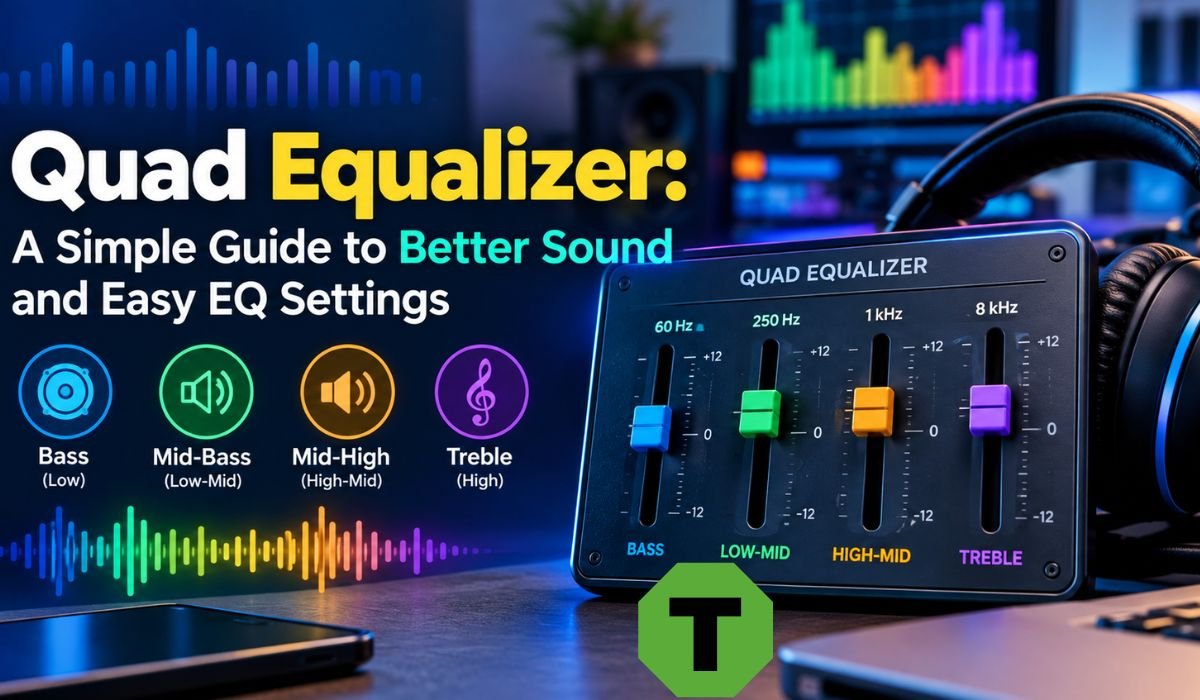
A Quad Equalizer can be a surprisingly useful tool when your audio sounds too boomy, dull, harsh, thin, or unclear. Instead of changing the overall volume, an equalizer lets you change selected parts of the audio spectrum. In a typical four-band design, those areas broadly cover low frequencies, low mids, high mids, and high frequencies. The result can be a cleaner and more balanced sound for music, gaming, podcasts, movies, headphones, speakers, and even car audio.
The word “Quad” can be slightly confusing, though. In some products, it means four adjustable frequency bands. In other equipment, it can describe four independent audio channels. Yamaha, for example, describes four-band parametric equalizers using low, low-mid, high-mid, and high sections, while other professional equipment may use different layouts.
The most important thing to remember is that there is no universal EQ curve that sounds perfect everywhere. Your headphones, speakers, room, recording, listening volume, and personal preference all matter. A good Quad Equalizer Setting therefore starts with listening, not with copying an extreme preset.
What Is a Quad Equalizer?
A Quad Equalizer is generally an equalization system that provides four adjustable frequency bands or, depending on the equipment, four independent EQ channels. Equalization works by selectively boosting or cutting portions of the audio frequency spectrum. Yamaha describes equalization as a way of adjusting the tonal character of sound, while Shure explains EQ as selectively boosting or cutting frequency bands to improve sound quality and intelligibility.
For a simple four-band audio EQ, the controls often represent Bass, Low-Mid, High-Mid, and Treble. Moving a control upward usually increases the selected range, while moving it downward reduces that range. A parametric design can provide additional control over the exact frequency and bandwidth. This makes a Quad Equalizer useful for broad tonal changes as well as more targeted corrections, depending on the design.
How Does a Quad Equalizer Work?
Every sound contains energy at different frequencies. Bass notes occupy the lower portion of the audible spectrum, while speech detail, cymbals, and other high-frequency information occupy progressively higher areas. An EQ changes the relative level of those areas without necessarily changing the entire signal equally.
Three controls are especially important on a parametric EQ: Frequency, Gain, and Q. Frequency identifies the center of the area being changed. Gain determines how much that area is boosted or reduced. Q, also called bandwidth, determines how wide the adjustment is. iZotope and Focusrite both describe these three controls as fundamental parts of parametric EQ.
A high Q generally creates a narrower adjustment, while a lower Q affects a wider range. That distinction matters because a narrow cut can target a particular resonance, whereas a broader adjustment can change the overall character of a sound. Not every Quad Equalizer includes adjustable Q, so users should check the controls available on their specific device or software.
Understanding The Four Main EQ Bands
The first area is the Low Frequency range, commonly associated with bass weight, kick drums, rumble, and physical impact. Too much energy here can make music or speech sound boomy. The second area is the Low-Mid Frequency range, which contributes warmth and body but can also create muddiness or a boxy character when excessive.
The third area is the High-Mid Frequency range. This is important for vocal presence, speech intelligibility, instrument attack, and perceived clarity. Too much emphasis can make a recording sound aggressive or tiring. The fourth area is the High Frequency or Treble region, which contributes brightness, cymbal detail, air, and some forms of vocal consonant detail.
These descriptions are useful guides rather than fixed rules. Different Quad Equalizers can place their bands at different frequencies. A four-band EQ should therefore be judged by the actual frequency labels and controls shown on the interface rather than by assuming every model uses identical crossover points.
Quad Equalizer Vs. Graphic And Parametric EQ
A Four-Band EQ describes how many bands are available; it does not automatically tell you what type of equalizer it is. A graphic equalizer normally has fixed frequency bands, while a parametric equalizer can let you select the center frequency and adjust the width of the affected range. Yamaha specifically notes that graphic EQs use fixed bands, while parametric EQs offer control over frequency, Q, and boost or attenuation.
This distinction becomes important when shopping for software or hardware. A simple four-band graphic-style EQ can be quick and beginner-friendly. A four-band parametric EQ can be more precise because you can target a particular problem rather than affecting a broad predetermined section. Meanwhile, a product described as a four-channel equalizer could contain multiple EQ bands on each of four separate signal paths.
Quick Bio Information
| Quick Fact | Information |
|---|---|
| Term | Quad Equalizer |
| Main Purpose | Frequency Balance And Tonal Adjustment |
| Common Design | Four-Band Audio EQ |
| Typical Bands | Low, Low-Mid, High-Mid, And High |
| Alternative Meaning | Four Independent EQ Channels |
| Main Control | Gain |
| Frequency Control | Selects The Area Being Adjusted |
| Q Control | Controls Bandwidth |
| Positive Gain | Boosts A Selected Range |
| Negative Gain | Cuts A Selected Range |
| Flat Setting | 0 dB Adjustment |
| Graphic EQ | Usually Uses Fixed Frequency Bands |
| Parametric EQ | Allows More Detailed Frequency Control |
| Common Uses | Music, Gaming, Voice, Movies, And Car Audio |
| Main Benefit | Better Tonal Balance |
| Major Limitation | Cannot Restore Missing Audio Information |
| Important Safety Point | Avoid Excessive Boosting And Clipping |
| Best Starting Point | Begin Flat And Make Small Changes |
Why Use A Quad Equalizer?
A Quad Equalizer can be helpful when the basic sound from a device does not match what you want to hear. Someone may find that headphones have too much treble, a soundbar produces excessive bass, or a podcast voice lacks presence. EQ gives that listener a way to adjust the balance without replacing the entire playback system.
It can also help when different listening situations require different profiles. Music may benefit from a natural tonal balance, while spoken content may benefit from greater vocal clarity. Gaming may call for a different balance again. The important point is that EQ is a correction and customization tool, not a replacement for good hardware, good recordings, or sensible setup.
How To Set A Quad Equalizer
The safest starting point is a Flat EQ, where the bands are set to 0 dB. Listen to a familiar recording and temporarily disable other enhancements such as bass boost, loudness processing, or virtual surround. This makes it easier to hear what the EQ itself is changing.
Next, identify one problem. If the sound is boomy, investigate the lower frequencies. If speech is buried, look toward the midrange. If headphones sound painfully bright, carefully examine the upper frequencies. Change only one control at first and use the bypass function to compare the result with the original sound.
Shure recommends approaching equalization gradually and using familiar material when making adjustments. Its guidance also emphasizes stopping once a system is clear and loud enough rather than continuing to change the sound simply because more adjustment is possible.
Easy Quad Equalizer Settings For Music
There is no single Best Quad Equalizer Setting For Music because music recordings and playback equipment vary considerably. A sensible starting point is a nearly flat profile. If the bass feels weak, a small low-frequency increase may add weight. If the bass is masking vocals, a small reduction can produce a cleaner result.
The same principle applies to treble. A small increase can make a dull playback system seem more open, while a small reduction can soften bright headphones. The goal is not to create the most dramatic EQ curve. It is to produce a balance that remains comfortable and natural across several familiar recordings.
Quad Equalizer Settings For Voice And Podcasts
Voice clarity is strongly influenced by the midrange and upper-midrange areas. Shure’s professional audio guidance notes that speech intelligibility can benefit from carefully selected frequency adjustments, while also warning that exact settings vary from one system to another.
For a podcast or video call, excessive low-frequency energy can make a voice sound thick or muddy. A modest reduction in that area may create more space for speech. A careful presence adjustment can then improve intelligibility. However, EQ is not a complete noise-removal system. Echo, keyboard sounds, traffic, room reflections, and changing background noise may require microphone improvements, noise suppression, or acoustic treatment instead.
Quad Equalizer Settings For Gaming
Gaming EQ should be approached with the same restraint. Heavy bass can make explosions and cinematic effects exciting, but it may also cover quieter sounds. A cleaner low end combined with controlled mid or high-frequency adjustment can make certain details easier to notice.
It is important not to confuse EQ with positional audio. A Quad Equalizer changes frequency balance; it does not independently create accurate three-dimensional positioning. Directional information depends on the game’s audio design, headphones or speakers, and any spatial-audio processing being used.
Headphones, Earbuds, Cars, And Small Speakers
Headphones and earbuds can have very different frequency responses, so a preset designed for one model may not work well on another. If a headset sounds excessively bright, a small high-frequency reduction may help. If vocals appear buried, the problem may involve the low-mid balance rather than simply requiring more treble.
Cars and small speakers present different challenges. Vehicle interiors can reinforce certain bass frequencies, while compact speakers may struggle with very deep bass. Increasing the bass control does not magically create deeper physical output. In some cases, reducing the boomiest area makes the remaining bass sound cleaner and more controlled.
Gain, Q, Frequency, And Headroom Explained
Gain determines how strongly a frequency range is boosted or cut. Frequency identifies where the adjustment is centered, and Q determines how wide the adjustment is. Focusrite explains that increasing Q makes a parametric band narrower, while lowering Q makes it wider.
Headroom is equally important. Several large boosts can raise signal peaks and cause clipping. iZotope notes that EQ changes can push peaks beyond the available digital level, making additional headroom important when applying boosts. If a Quad Equalizer includes a Preamp or Output control, reducing the overall level can help accommodate aggressive boosts.
Should You Boost Or Cut Frequencies?
Many beginners instinctively boost the frequency they want to hear more clearly. Sometimes that works, but cutting an excessive frequency can be cleaner. If a speaker is overly boomy, reducing the problematic low range may work better than boosting every other frequency.
The same principle applies to harshness. Instead of increasing bass and mids to make treble seem less dominant, a modest treble reduction may solve the actual problem. Focusrite and Shure both emphasize careful, controlled EQ rather than unnecessary dramatic changes.
Common Quad Equalizer Mistakes
One common mistake is pushing every band upward. This may make the signal louder, but louder does not automatically mean better. Another mistake is using a dramatic preset without checking the actual frequencies controlled by the EQ. A preset created for one headphone or speaker can behave very differently on another.
Stacked processing is another issue. A phone, operating system, music application, Bluetooth speaker, and headphone application may each apply their own sound processing. Multiple EQ stages can produce an unexpected tonal balance and may increase the possibility of clipping. Keeping track of active processing makes troubleshooting much easier.
Features Worth Looking For
A useful Quad Equalizer may offer adjustable frequency points, gain controls, Q or bandwidth adjustment, output trim, bypass, and saved presets. Channel linking can be useful when several outputs need similar treatment, while a spectrum analyzer can provide visual information about frequency energy.
A spectrum display should not be treated as an automatic answer. A graph can show where energy exists, but it cannot decide what sounds natural to every listener. Yamaha’s EQ guidance similarly distinguishes between the technical controls available and the practical judgment involved in applying them.
What A Quad Equalizer Cannot Fix
EQ is powerful, but its limitations are just as important as its benefits. It cannot repair a physically damaged speaker, restore audio information that was never captured, or turn a small driver into a true subwoofer. It also cannot solve every room-acoustic problem.
Shure notes that equalization cannot fully correct issues caused by reverberation, reflections, mechanical vibration, excessive background noise, or poor physical system design. Sometimes moving a speaker, improving microphone placement, changing headphone fit, or reducing room reflections can produce a bigger improvement than another EQ adjustment.
Final Thoughts
A Quad Equalizer does not need to be complicated. At its simplest, it gives you four ways to reshape the balance of an audio signal. The most useful approach is to start flat, listen carefully, identify one problem, make a small adjustment, and compare the result with the original.
There is no universal setting that will make every headphone, speaker, song, podcast, game, or car system sound perfect. The better approach is to understand what each band does and make changes that have a clear purpose. Once you understand Bass, Low-Mid, High-Mid, Treble, Gain, Q, and Headroom, even a simple four-band EQ becomes a practical tool for creating cleaner and more comfortable sound.
FAQs About Quad Equalizer
What Is A Quad Equalizer?
A Quad Equalizer generally refers to an equalizer with four adjustable frequency bands, although some equipment uses “Quad” to describe four independent EQ channels. In a typical four-band audio design, the controls cover Low, Low-Mid, High-Mid, and High frequencies.
What Are The Four Bands In A Quad Equalizer?
A typical four-band EQ divides sound into Low, Low-Mid, High-Mid, and High or Treble areas. These sections broadly control bass weight, warmth and body, vocal presence and clarity, and brightness or high-frequency detail.
What Is The Best Quad Equalizer Setting?
There is no universal best setting. The appropriate adjustment depends on the playback device, recording, room, listening volume, and personal preference. Starting with all bands at 0 dB and making small changes is a practical approach.
Can A Quad Equalizer Improve Voice Clarity?
Yes, careful EQ can improve perceived voice clarity by reducing excessive low-frequency energy or making appropriate midrange adjustments. However, EQ cannot fully correct poor microphone placement, strong room reflections, echo, or background noise.
Can A Quad Equalizer Improve Gaming Audio?
It can change the balance of game sounds and may make some details easier to hear. However, EQ does not create positional audio. Spatial accuracy also depends on the game’s audio system, playback hardware, and spatial processing.
Can EQ Settings Cause Distortion?
Yes. Large boosts can increase signal peaks and reduce available headroom. If the resulting signal exceeds the system’s available level, clipping or distortion can occur. Lowering the preamp or output level can provide additional headroom.
Is A Four-Band EQ The Same As A Parametric EQ?
No. “Four-band” describes the number of bands, while “parametric” describes the type of control available. A four-band EQ can be parametric, but it can also use fixed or less adjustable bands. Parametric EQ commonly provides Frequency, Gain, and Q controls.
Can A Quad Equalizer Fix Bad Speakers?
It can sometimes improve the tonal balance of speakers, but it cannot overcome fundamental hardware limitations. EQ cannot repair a damaged driver or create deep bass that the speaker physically cannot reproduce. Good speaker placement and appropriate equipment remain important.
Learn more and explore exciting content on: Sosoactive: A Complete Guide to Its Features, Topics, and Digital Experience
[…] Learn more and explore exciting content on: Quad Equalizer: A Simple Guide to Better Sound and Easy EQ Settings […]