
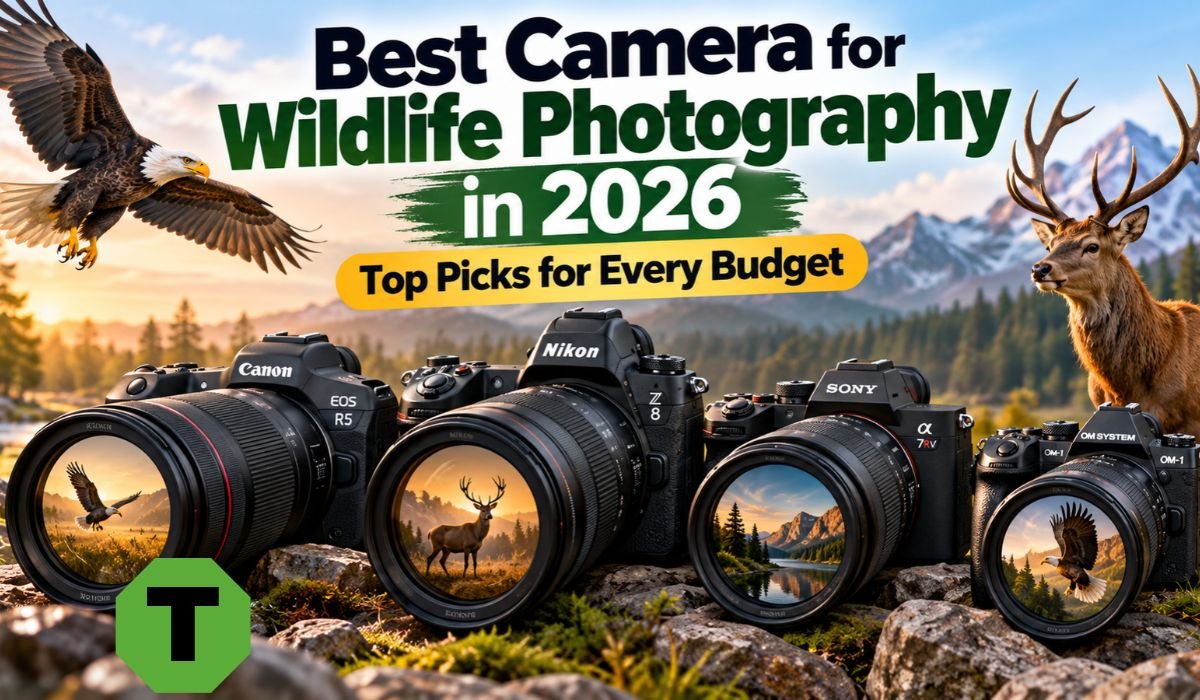
Wildlife photography brings us closer to the natural world, capturing everything from colorful birds in flight to powerful animals moving through forests. However, getting that perfect photograph isn’t always easy. Animals move quickly, lighting changes unexpectedly, and photographers often have only seconds to capture a memorable moment. That’s why choosing the Best Camera for wildlife photography can make a real difference.
In 2026, wildlife photographers have more choices than ever. Modern mirrorless cameras offer intelligent autofocus, impressive image quality, and fast shooting speeds. Meanwhile, affordable APS-C cameras and compact systems make wildlife photography accessible to beginners without requiring expensive professional equipment.
Whether you’re photographing birds in your garden, exploring national parks, or documenting animals professionally, the right camera depends on your budget and photography goals. This guide explores the best wildlife photography cameras, essential features, useful settings, and practical buying advice to help you choose confidently.
Quick Bio Information: Wildlife Camera Facts for 2026
| Camera Feature | Quick Information |
|---|---|
| Photography Category | Wildlife and Nature Photography |
| Best Overall Candidate | Nikon Z8 |
| Best Budget Candidate | Canon EOS R50 |
| Best Beginner Wildlife Camera | Canon EOS R7 |
| Best Professional Candidate | Sony A9 III |
| Best High-Resolution Candidate | Canon EOS R5 Mark II |
| Best Compact System Candidate | OM System OM-1 Mark II |
| Best Camera Type | Mirrorless for most new buyers |
| Popular Sensor Types | Full-Frame, APS-C, Micro Four Thirds |
| Important Autofocus Feature | Animal and Bird Subject Detection |
| Useful Burst Speed | Around 10–30 fps for many situations |
| Recommended Wildlife Lens | 100–400mm or longer |
| Common Bird Photography Lens | 150–600mm or similar |
| Useful Shutter Speed | 1/1000 second or faster for moving wildlife |
| Preferred Image Format | RAW for greater editing flexibility |
| Essential Outdoor Feature | Weather-Resistant Construction |
| Helpful Camera Accessory | Spare Batteries and Fast Memory Cards |
| Best Time for Wildlife Photography | Early Morning and Late Afternoon |
What Makes a Camera Good for Wildlife Photography?
The best wildlife camera combines fast autofocus, reliable tracking, good image quality, and comfortable handling. Unlike portrait or landscape photography, wildlife photography often involves subjects that won’t stay still. A bird may suddenly take flight, while a deer might disappear into trees before you can adjust your settings.
Animal-eye detection and continuous autofocus help maintain focus on moving subjects. High-speed burst shooting increases the chance of capturing the right moment, although buffer capacity matters just as much as advertised frames per second. Sensor performance also becomes important when photographing animals in shaded forests or during sunrise.
Durability shouldn’t be overlooked. A weather-resistant body, dependable battery, and comfortable grip make long outdoor sessions easier. Most importantly, consider the complete camera system. Even an expensive camera struggles to photograph distant wildlife without a suitable telephoto lens.
Best Cameras for Wildlife Photography in 2026: Quick Comparison
Several cameras stand out for different wildlife photography needs. The Nikon Z8 offers a strong combination of resolution, speed, and autofocus. Canon’s EOS R7 provides excellent reach-oriented APS-C performance, while the Sony A9 III specializes in extremely fast action photography.
The Canon EOS R5 Mark II appeals to photographers who want detailed images and advanced tracking. Meanwhile, the OM System OM-1 Mark II provides a relatively portable system with powerful computational features.
| Camera | Sensor | Resolution | Notable Burst Capability |
|---|---|---|---|
| Nikon Z8 | Full-Frame | 45.7 MP | Up to 20 fps RAW |
| Canon EOS R7 | APS-C | 32.5 MP | Up to 30 fps electronic |
| Sony A9 III | Full-Frame | 24.6 MP | Up to 120 fps electronic |
| Canon EOS R5 Mark II | Full-Frame | 45 MP | Up to 30 fps electronic |
| OM System OM-1 Mark II | Micro Four Thirds | 20.4 MP | Up to 50 fps with compatible continuous autofocus settings |
These are maximum or selected shooting capabilities, not guaranteed speeds in every configuration. Lens compatibility, autofocus mode, file format, and other settings can affect performance.
Best Camera for Wildlife Photography Overall: Nikon Z8
The Nikon Z8 is an excellent all-round choice for serious wildlife photographers. Its 45.7-megapixel full-frame sensor captures detailed images, while advanced subject detection and 3D tracking help follow unpredictable animals. The camera shoots up to 20 frames per second in RAW, making it suitable for birds in flight and fast-moving mammals.
Its stacked sensor minimizes rolling-shutter distortion, and its weather-resistant construction is useful outdoors. The main disadvantages are its premium price, substantial weight, and demanding storage requirements. For photographers who need professional performance without choosing a larger flagship body, the Nikon Z8 offers a compelling balance.
Best Budget Camera for Wildlife Photography
The Canon EOS R50 is a practical starting point for photographers with limited budgets. Its 24.2-megapixel APS-C sensor, subject-detection autofocus, and compact design make it suitable for learning wildlife photography.
Although it lacks in-body image stabilization and advanced weather sealing, it can produce impressive photographs with the right lens. Pairing it with an affordable RF telephoto zoom provides greater reach for birds and distant animals.
The important lesson is that budget wildlife photography depends on more than the camera body. A reasonably priced camera with a suitable long lens can be more useful than an expensive body paired with a short kit lens.
Best Camera for Wildlife Photography Beginners: Canon EOS R7
The Canon EOS R7 is particularly attractive for beginners who want equipment they can continue using as their skills improve. Its 32.5-megapixel APS-C sensor provides detailed images, while subject-tracking autofocus helps follow birds and animals.
The camera offers up to 15 fps with its mechanical shutter and 30 fps electronically. Built-in image stabilization and dual memory card slots add flexibility.
Its APS-C sensor provides a narrower field of view than full-frame cameras when using the same focal length. This can be helpful when photographing distant wildlife, although it doesn’t physically increase lens magnification. Overall, the R7 combines accessible controls with serious wildlife photography capabilities.
Best Professional Camera for Wildlife Photography: Sony A9 III
The Sony A9 III is designed for photographers who prioritize speed. Its 24.6-megapixel full-frame global-shutter sensor allows electronic shooting at up to 120 frames per second with compatible settings.
Unlike conventional rolling-shutter sensors, its global shutter captures the entire image at once. This helps prevent distortion when photographing rapidly moving wings, running animals, or sudden action.
Advanced autofocus and pre-capture capabilities further improve its usefulness for unpredictable moments. However, the high price and comparatively modest resolution make it less suitable for photographers who mainly capture stationary wildlife or require extensive cropping.
Best High-Resolution Camera for Wildlife Photography
The Canon EOS R5 Mark II is an excellent candidate for photographers who value fine detail. Its 45-megapixel full-frame sensor offers substantial cropping flexibility, particularly useful when animals remain too far away to fill the frame.
Advanced subject detection, in-body stabilization, and high-speed electronic shooting make it versatile for both wildlife portraits and action photography.
Its hybrid capabilities also appeal to photographers who record nature videos. However, large image files require fast storage and sufficient editing capacity. Photographers should also consider the total cost of compatible telephoto lenses before investing in this premium system.
Best Mirrorless Camera for Wildlife Photography
Mirrorless cameras have become a leading choice for wildlife photography because of their intelligent autofocus systems, electronic viewfinders, and fast shooting capabilities.
The Nikon Z8, Canon EOS R7, and Sony A9 III demonstrate how different mirrorless systems serve different needs. Some prioritize resolution, others offer affordability, and certain professional models focus on exceptional speed.
Traditional DSLRs remain capable, especially when photographers already own compatible lenses. Nevertheless, modern mirrorless cameras generally provide more advanced subject recognition and wider autofocus coverage.
When choosing between systems, compare telephoto lens availability, handling, battery performance, and upgrade options rather than concentrating only on camera specifications.
Best Camera for Bird Photography in 2026
Bird photography requires quick reactions, dependable autofocus, and substantial lens reach. Small birds can be difficult to locate, while flying subjects demand accurate tracking and fast shutter speeds.
The Canon EOS R7 is particularly useful because its APS-C sensor combines high resolution with a narrower field of view. The Nikon Z8 is another strong option for photographers who need professional autofocus and excellent image detail.
A telephoto lens reaching 400mm, 500mm, or 600mm can make a significant difference. For birds in flight, starting around 1/2000 second may help freeze movement, although larger birds and slower action may require less speed.
Good technique and knowledge of bird behavior remain just as important as equipment.
Best Camera for Wildlife Photography in Low Light
Wildlife often becomes active early in the morning or near sunset, when available light is limited. Under these conditions, photographers need to balance shutter speed, aperture, and ISO carefully.
Full-frame cameras such as the Nikon Z8 can provide useful high-ISO performance, particularly when paired with fast telephoto lenses. However, sensor size alone doesn’t determine image quality.
A lens with an f/2.8 or f/4 maximum aperture allows more light than a comparable f/6.3 lens, potentially enabling faster shutter speeds.
Image stabilization helps reduce camera shake, but it cannot freeze a moving animal. Photographers should prioritize an appropriate shutter speed and accept some ISO noise rather than producing a blurred photograph.
Best Camera for Travel and Outdoor Wildlife Adventures
The OM System OM-1 Mark II is worth considering for photographers who regularly hike or travel. Its 20.4-megapixel Micro Four Thirds sensor and compact lens ecosystem can reduce the size of a long-reach wildlife setup.
The camera includes weather-resistant construction, sophisticated stabilization, and computational photography features. Its Pro Capture function is especially useful for recording moments immediately before a photographer fully presses the shutter button.
Its smaller sensor may be less forgiving in extremely low light than some full-frame alternatives. Nevertheless, photographers who prioritize portability and telephoto reach may find the overall system particularly appealing.
How to Choose the Best Camera for Your Budget
Choosing the best camera starts with understanding how much you can spend on the complete setup. Entry-level buyers should consider affordable APS-C bodies and practical telephoto zoom lenses rather than spending their entire budget on the camera.
Mid-range buyers can explore models such as the Canon EOS R7, which offers stronger controls, faster shooting, and greater flexibility.
Premium buyers may prefer the Nikon Z8, Canon EOS R5 Mark II, or Sony A9 III, depending on whether resolution, balanced performance, or speed matters most.
Remember that camera prices vary by country, retailer, and promotions. Compare current local prices and warranty coverage before purchasing. Reserving enough money for lenses and accessories is usually a smarter decision than buying the most expensive body possible.
Best Camera Settings for Wildlife Photography
Camera settings can have a greater impact on image quality than upgrading equipment. For moving animals, shutter speeds around 1/1000 second provide a useful starting point. Birds in flight may require 1/2000 second or faster, depending on their movement.
Aperture settings between f/4 and f/8 are common, although the best choice depends on available light and desired depth of field. Auto ISO can simplify exposure when animals move between sunlight and shade.
Continuous autofocus and animal-eye detection improve tracking, while burst mode helps capture fleeting expressions and movements.
RAW files provide greater editing flexibility, especially for recovering highlights and adjusting exposure. However, JPEG remains useful when photographers need smaller files and faster sharing.
Best Lenses and Accessories for Wildlife Photography
A suitable lens is essential for successful wildlife photography. Telephoto zooms such as 100–400mm and 150–600mm offer flexibility when photographing animals at different distances.
Longer lenses help maintain a respectful distance from wildlife, while image stabilization makes handheld shooting more manageable. A monopod can reduce fatigue when using heavy equipment.
Fast memory cards are important for extended bursts, especially with high-resolution cameras. Spare batteries, weather protection, and a comfortable camera bag are also valuable.
Photographers should check lens compatibility carefully because camera mounts differ. Third-party lenses can offer good value, but autofocus features and performance may vary between camera systems.
Wildlife Photography Tips for Beginners and Professionals
Successful wildlife photography begins with patience and observation. Understanding animal behavior helps photographers anticipate movement rather than reacting after the moment has passed.
Early morning and late afternoon often provide attractive natural light. Shooting from an animal’s eye level can create more engaging photographs, while uncluttered backgrounds help the subject stand out.
Beginners can practice with birds in gardens, parks, and nature reserves before attempting more challenging wildlife encounters.
Always prioritize animal welfare. Avoid disturbing nests, approaching young animals, or using bait that changes natural behavior. Respect local regulations and maintain safe distances. A memorable photograph should never come at the expense of wildlife safety.
Final Thoughts: Which Wildlife Photography Camera Should You Buy in 2026?
Finding the Best Camera for Wildlife Photography in 2026 doesn’t mean purchasing the most expensive model. It means selecting equipment that matches your subjects, experience, and financial priorities.
The Nikon Z8 stands out as a versatile premium choice, while the Canon EOS R7 offers excellent value for enthusiastic wildlife photographers. The Canon EOS R50 makes a sensible starting point, and the Sony A9 III is particularly impressive for high-speed action. For travelers, the OM System OM-1 Mark II offers a compelling balance of portability and capability.
Ultimately, a reliable camera, suitable telephoto lens, thoughtful settings, and patient observation will help you capture more meaningful wildlife photographs. The best equipment supports your creativity without distracting you from the natural world.
Frequently Asked Questions About Wildlife Photography Cameras
What Is the Best Camera for Wildlife Photography in 2026?
The Nikon Z8 is a strong overall choice because it combines high resolution, advanced autofocus, and fast continuous shooting. However, the best camera depends on your budget, lens requirements, and preferred subjects.
Which Camera Is Best for Wildlife Photography Beginners?
The Canon EOS R50 is suitable for budget-conscious beginners, while the Canon EOS R7 offers more advanced features for photographers planning to develop their skills.
Is Mirrorless Better Than DSLR for Wildlife Photography?
Modern mirrorless cameras generally offer stronger animal-detection autofocus and faster electronic shooting. DSLRs remain useful, particularly for photographers who already own compatible telephoto lenses.
How Many Megapixels Are Needed for Wildlife Photography?
Around 20–24 megapixels can produce excellent wildlife photographs. Higher resolutions, such as 32 or 45 megapixels, provide additional cropping flexibility when subjects are distant.
What Is the Best Budget Camera for Wildlife Photography?
The Canon EOS R50 is an affordable candidate. Its compact body and subject-detection autofocus make it appealing, although buyers should budget for a suitable telephoto lens.
Which Camera Is Best for Birds in Flight?
The Sony A9 III offers exceptional speed, while the Nikon Z8 and Canon EOS R7 provide strong alternatives with different price and resolution advantages.
Is Full-Frame Better Than APS-C for Wildlife Photography?
Full-frame cameras often provide advantages in low light, while APS-C cameras offer a narrower field of view with the same lens. Neither format is automatically better for every situation.
What Lens Is Best for Wildlife Photography?
A 100–400mm telephoto zoom is versatile for general wildlife. Bird photographers often benefit from longer lenses reaching 500mm or 600mm, depending on shooting distance and budget.
Learn more and explore exciting content on: DreamMeaniing.com Contact: How to Reach the Team and Get Help
[…] Learn more and explore exciting content on: Best Camera for Wildlife Photography in 2026: Top Picks for Every Budget […]