
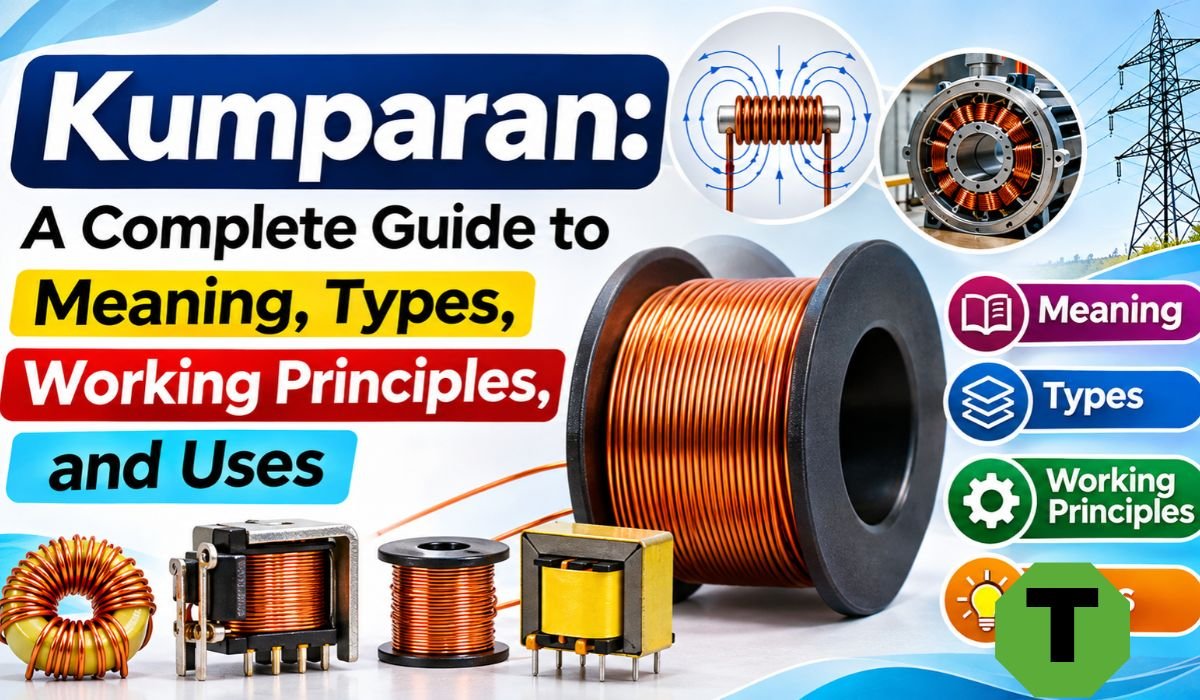
Electricity powers almost everything around us, from household appliances and smartphones to industrial machines and transportation systems. Behind many of these technologies is a simple but essential electrical component called Kumparan, commonly known as an electrical coil.
Kumparan plays an important role in producing magnetic fields, transferring electrical energy, and controlling electrical circuits. Although its structure may appear simple, its working principles support some of the most important technologies used today.
Electrical coils are found in transformers, electric motors, generators, communication equipment, and electronic devices. Their ability to interact with electric current and magnetic fields makes them valuable in both traditional electrical engineering and modern technology.
Understanding Kumparan helps explain how electricity and magnetism work together. This guide explores its meaning, construction, working principles, types, applications, advantages, and maintenance requirements.
What Is Kumparan? Meaning and Definition
Kumparan is an Indonesian word meaning a coil or winding. In electrical engineering, Kumparan Listrik refers to conductive wire arranged into loops or turns to perform an electromagnetic function.
These windings are commonly made from copper or aluminum because both materials conduct electricity effectively. The wire usually has an insulating coating that prevents neighboring turns from making unwanted electrical contact.
When electric current flows through a coil, it produces a magnetic field. The strength and distribution of this field depend on the current, winding arrangement, and surrounding materials.
Kumparan can also respond to changing magnetic fields. Through electromagnetic induction, a changing magnetic flux can generate voltage across its terminals.
This combination of properties makes electrical coils useful in energy conversion, voltage regulation, magnetic actuation, and electronic circuit design.
Quick Bio Information About Kumparan
The following reference table summarizes the most important technical facts about Kumparan.
| Information | Details |
|---|---|
| Common Name | Kumparan |
| English Meaning | Electrical Coil or Winding |
| Indonesian Term | Kumparan Listrik |
| Scientific Field | Electrical Engineering |
| Main Structure | Wound Conductive Wire |
| Common Conductor | Copper |
| Alternative Conductor | Aluminum |
| Primary Principle | Electromagnetism |
| Important Property | Inductance |
| Inductance Unit | Henry |
| Magnetic Field Source | Electric Current |
| Common Core Materials | Air, Iron, Ferrite |
| Electrical Operation | AC and DC Applications |
| Energy Storage | Magnetic Field |
| Major Equipment | Transformers and Motors |
| Measurement Application | Moving-Coil Galvanometers |
| Common Problems | Overheating and Insulation Damage |
| Modern Applications | Electric Vehicles and Power Electronics |
How Does Kumparan Work?
The working principle of Kumparan begins with the relationship between electricity and magnetism. Whenever electric current passes through a conductor, a magnetic field forms around it.
When the conductor is wound into a coil, the magnetic fields created by individual turns combine. This arrangement can produce a stronger and more concentrated field than a single straight wire under comparable conditions.
The direction of current determines the direction of the magnetic field. Reversing the current also reverses the field’s direction.
Another important principle is electromagnetic induction. When the magnetic flux linked with a coil changes, an electromotive force is induced. This principle explains how transformers and generators operate.
A coil also resists sudden changes in current through a property called inductance. This behavior helps control current fluctuations in electronic circuits.
With direct current, an ideal coil produces a steady magnetic field after the current stabilizes. With alternating current, the continuously changing current creates a changing magnetic field.
Main Components and Structure of Kumparan
The construction of Kumparan directly influences its performance. Most electrical coils contain conductive wire, insulation, and a supporting structure. Some designs also include a magnetic core.
Copper is widely used because it offers excellent conductivity and relatively low electrical resistance. Aluminum is lighter and can be more economical, although a larger conductor cross-section is generally needed for similar resistance.
Insulation separates neighboring turns and protects against unwanted electrical connections. Damaged insulation may cause short circuits and overheating.
The magnetic core is another important feature. Iron and ferrite cores can increase magnetic flux and inductance compared with air-core designs of similar dimensions.
The number of turns, winding diameter, wire thickness, and spacing also affect electrical characteristics.
For example, increasing the number of turns often increases inductance, although the exact result depends on the coil’s geometry and magnetic circuit.
Good coil design balances electrical efficiency, mechanical strength, temperature control, and available space.
Different Types of Kumparan and Their Functions
Electrical coils come in several forms, each designed for particular operating conditions.
An Air-Core Kumparan does not contain a ferromagnetic core. These coils are commonly used in radio-frequency circuits because they avoid magnetic core saturation and certain core-related losses.
An Iron-Core Kumparan uses a magnetic material to concentrate magnetic flux. Such coils are useful in transformers, electromagnets, and low-frequency electrical equipment.
A Solenoid Kumparan typically has a cylindrical winding arrangement. When energized, it produces a magnetic field that can operate a movable plunger in devices such as valves and relays.
A Toroidal Kumparan has a ring-shaped configuration. Its geometry can help contain magnetic flux and reduce external magnetic interference.
Transformer windings transfer energy between circuits through mutual induction, while inductor coils are designed primarily to provide a specified inductance.
Each type serves a different purpose, making proper selection important.
Understanding Inductance and Electromagnetic Properties
Inductance is one of the most important properties of Kumparan. It describes how a coil responds to changes in electric current.
When current changes, the magnetic flux associated with the coil changes as well. This produces an induced voltage that opposes the change in current, according to Lenz’s law.
Inductance is measured in henries, represented by the symbol H.
A coil’s inductance depends on its number of turns, physical dimensions, and magnetic core properties.
Electrical coils also store energy in magnetic fields. This energy can return to the circuit when the current decreases.
However, real coils are not perfect. Their conductors have resistance, and magnetic cores may introduce additional losses.
Understanding these characteristics helps engineers design efficient power supplies, filters, and energy conversion systems.
Kumparan in Transformers and Power Systems
Transformers are among the most familiar applications of electrical coils.
A conventional transformer contains primary and secondary windings linked through a magnetic core. Alternating current in the primary winding creates changing magnetic flux, which induces voltage in the secondary winding.
The relationship between winding turns determines the voltage ratio in an ideal transformer.
A step-up transformer increases voltage, while a step-down transformer reduces it.
Transformers are essential in electricity distribution because they allow electrical energy to be transmitted and delivered at suitable voltage levels.
Smaller transformers also appear in power supplies, electronic equipment, and industrial control systems.
Their performance depends on winding resistance, insulation, core properties, operating frequency, and thermal management.
How Kumparan Works in Electric Motors and Generators
Electric motors and generators demonstrate how coils connect electrical and mechanical energy.
In an electric motor, current flowing through windings interacts with magnetic fields to produce electromagnetic forces and torque.
Depending on the motor design, windings may be located in the stator, rotor, or both.
Generators operate through electromagnetic induction. When magnetic flux linked with a winding changes, voltage is induced.
This process converts mechanical energy into electrical energy.
Both machines depend on carefully designed windings to achieve reliable operation.
Poor winding insulation, excessive resistance, or overheating can reduce performance and eventually damage the equipment.
Modern electric vehicles, industrial motors, and renewable energy generators continue to rely on these fundamental electromagnetic principles.
Kumparan in Electrical Measuring Instruments
Kumparan also has an important history in electrical measurement.
One example is the moving-coil galvanometer, an instrument designed to detect small electrical currents.
In this device, a movable coil sits within a magnetic field. When current passes through the coil, electromagnetic torque causes it to rotate.
Some sensitive galvanometers use a small mirror attached to the moving assembly.
A beam of light reflects from the mirror onto a distant scale. As the coil rotates, the reflected light spot moves across the scale.
This arrangement acts like a long, nearly massless pointer, allowing very small angular movements to become visible.
The technique demonstrates how electromagnetic forces and optical measurement can work together.
Common Uses of Kumparan in Everyday Life
Kumparan is present in many devices people use without thinking about their internal components.
Household fans, washing machines, refrigerators, and air conditioners contain electric motors that use windings.
Electronic power supplies use inductors and transformers to manage electrical energy and control voltage.
Automotive systems contain coils in ignition equipment, relays, actuators, and electric drive motors.
Speakers use voice coils that interact with magnetic fields to move their diaphragms and produce sound.
Wireless charging systems use magnetic coupling between coils to transfer energy over short distances.
Radio-frequency circuits also use inductors for tuning and filtering.
These applications demonstrate how a simple winding of wire supports many different technologies.
Advantages and Limitations of Kumparan
Electrical coils offer several advantages. They can generate magnetic fields, store magnetic energy, transfer electrical power, and create mechanical movement.
Their construction is adaptable, allowing manufacturers to develop coils for small electronic devices or large industrial equipment.
However, Kumparan also has limitations.
Electrical resistance causes energy losses and heating. Magnetic cores may experience saturation, while alternating magnetic fields can create additional losses.
Coils can also introduce electromagnetic interference if equipment is not properly designed.
Large inductance values may require significant physical space, depending on the application.
These limitations do not make coils ineffective. Instead, they highlight the importance of selecting appropriate materials, dimensions, and operating conditions.
Factors That Affect Kumparan Performance
Several factors determine how efficiently and reliably Kumparan operates.
The number of turns influences magnetic behavior and inductance. Wire thickness affects electrical resistance and current-carrying capability.
Core material influences magnetic permeability, saturation characteristics, and energy losses.
Operating frequency also matters. At higher frequencies, skin effect, proximity effect, and core losses may become significant.
Temperature is another major consideration. As copper heats up, its electrical resistance generally increases.
Excessive temperatures can weaken insulation and shorten equipment life.
Proper winding design therefore requires attention to electrical, magnetic, mechanical, and thermal characteristics.
Common Kumparan Problems and Maintenance
Like other electrical components, Kumparan can develop faults over time.
Overheating is a common problem caused by excessive current, inadequate cooling, or internal faults.
Broken conductors can create open circuits, preventing normal current flow.
Damaged insulation may produce short circuits between turns, potentially causing localized heating and reduced performance.
Unusual smells, visible discoloration, abnormal noise, and unexpected equipment shutdowns can indicate problems.
Basic maintenance involves keeping equipment clean, dry, and adequately ventilated.
Resistance and continuity testing can help identify certain faults, but they cannot reliably detect every shorted turn.
Electrical equipment must be disconnected, safely isolated, and checked for stored energy before inspection. High-voltage testing and internal repairs should be performed by qualified professionals.
Kumparan vs. Inductor and Its Importance in Modern Technology
Although Kumparan and inductor are closely related, they are not identical terms.
Kumparan describes a coil or winding structure. An inductor is an electrical component designed to provide inductance within a circuit.
An inductor often contains a coil, but not every coil functions as a standalone inductor.
For example, transformer windings transfer energy between circuits, while motor windings participate in electromagnetic torque production.
In modern technology, coils remain essential to electric vehicles, renewable energy systems, automation equipment, and power electronics.
Advances in magnetic materials, insulation, and manufacturing continue to improve their performance.
Even as electronic systems become smaller and more sophisticated, the basic principles of Kumparan remain remarkably important.
FAQs About Kumparan
What Is Kumparan in Electrical Engineering?
Kumparan is a coil made from conductive wire arranged into turns or loops. It is used to produce magnetic fields, provide inductance, transfer electrical energy, or interact with magnetic fields in electrical equipment.
How Does Kumparan Produce a Magnetic Field?
When electric current flows through the wire, a magnetic field forms around the conductor. Winding the wire into loops allows the fields from individual turns to combine, producing a useful magnetic field.
What Are the Main Types of Kumparan?
Common types include air-core coils, iron-core coils, solenoids, toroidal coils, transformer windings, and inductor coils. Each has different electrical characteristics and applications.
What Is the Purpose of Kumparan in a Transformer?
Transformer windings allow electrical energy to transfer between circuits through electromagnetic induction. Changing magnetic flux links the primary and secondary windings, inducing voltage in the secondary.
Why Does Kumparan Become Hot?
Coils generate heat because their conductors have electrical resistance. Additional heating may result from magnetic core losses, excessive current, poor ventilation, or internal faults.
Can Kumparan Work With AC and DC?
Yes. Coils can operate in both alternating-current and direct-current systems. Their behavior depends on the application, circuit design, magnetic core, and operating conditions.
What Is the Difference Between Kumparan and an Inductor?
Kumparan refers to a physical coil or winding, while an inductor is a circuit component designed to provide inductance. Many inductors use coils, but coils also serve other purposes.
Where Is Kumparan Used in Everyday Life?
Kumparan appears in electric motors, transformers, speakers, wireless chargers, electronic power supplies, household appliances, and automotive electrical systems.
Final Thoughts
Kumparan may look like a simple arrangement of wire, but its importance in electrical engineering is enormous. Its ability to create magnetic fields, respond to changing magnetic flux, and support energy conversion makes it essential in countless technologies.
From traditional transformers and measuring instruments to modern electric vehicles and wireless charging systems, electrical coils continue to perform critical functions.
Understanding Kumparan also provides a useful foundation for learning about electromagnetism, inductance, electric motors, and electronic circuits.
As technology continues to develop in 2026 and beyond, electrical coils will remain fundamental components of efficient and reliable electrical systems.
Learn more and explore exciting content on: Moss Agate: Meaning, Benefits, Properties, and Uses Explained
[…] Learn more and explore exciting content on: Kumparan: A Complete Guide to Meaning, Types, Working Principles, and Uses […]