
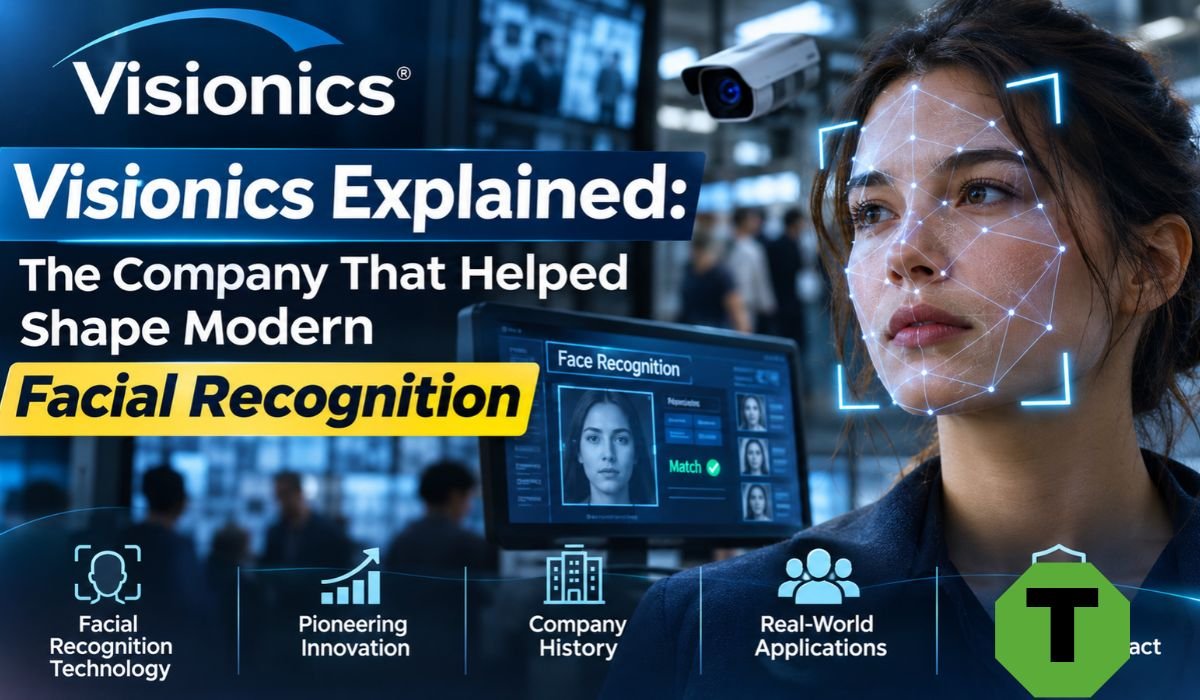
Facial recognition has become a familiar part of modern life. From unlocking smartphones to verifying identities at airports, this technology has changed how people interact with digital security systems. However, long before these applications became widespread, companies like Visionics were exploring how computers could recognize human faces.
Visionics was an American biometric technology company that helped introduce automated facial recognition into commercial and government environments. Its flagship software, FaceIt, represented an important development in computer vision and digital identification.
Although the original company stopped operating independently in 2002, its achievements and challenges remain relevant in 2026. Its history offers valuable insights into technological innovation, biometric security, personal privacy, and the importance of responsible artificial intelligence.
What Is Visionics?
Visionics Corporation was an American technology company specializing in biometric identification, facial recognition, fingerprint imaging, and digital identity management. Its primary goal was to develop computer-based solutions that could recognize individuals through measurable physical characteristics.
The company served a market that included government agencies, law enforcement organizations, and commercial security providers. Unlike traditional identification methods that relied on passwords, documents, or access cards, biometric technology introduced the possibility of using physical characteristics to establish identity.
Visionics helped move automated facial recognition beyond academic research and into practical business applications. Its work formed part of the early commercial foundation of today’s biometric security industry.
Visionics Quick Bio Information
| Company Information | Details |
|---|---|
| Company Name | Visionics Corporation |
| Country of Origin | United States |
| Industry | Biometric Technology |
| Prominent Co-Founder | Joseph J. Atick |
| Early Corporate History | 1994 |
| Business Type | Technology and Security |
| Primary Focus | Facial Recognition |
| Flagship Software | FaceIt |
| Core Technology | Local Feature Analysis |
| Additional Products | LiveScan, IBIS, BNP |
| Main Applications | Biometric Identification |
| Former Stock Exchange | Nasdaq |
| Former Stock Symbol | VSNX |
| First Major Merger | Digital Biometrics |
| Digital Biometrics Merger | February 15, 2001 |
| Identix Merger | June 25, 2002 |
| Major Controversy | Tampa Surveillance Project |
| Current Status | No Longer Operating Independently |
| Historical Legacy | Early Commercial Facial Recognition |
History and Origins of Visionics
The history of Visionics dates back to the development of biometric recognition technologies during the 1990s. At that time, computers were considerably less powerful than modern devices, making automated facial recognition a difficult technical challenge. Researchers needed to develop mathematical methods that could distinguish individual faces despite changes in lighting, facial expressions, and camera angles. Visionics pursued these challenges while exploring opportunities to commercialize its research. Its approach combined scientific development with practical security applications, helping establish biometric identification as an emerging technology market. The company’s progress reflected a broader shift toward digital security, where computers could assist with identification tasks previously performed by people.
Who Founded Visionics?
Joseph J. Atick was a prominent co-founder and executive associated with Visionics. A researcher and technology entrepreneur, Atick recognized the potential of automated facial recognition beyond academic environments. Historical company records associate him with the leadership of Visionics Technology Corporation beginning in 1994. His work focused on transforming mathematical recognition techniques into commercially useful technologies. Atick also played an important role in the company’s corporate expansion, including its merger with Digital Biometrics. He later became president and chief executive officer of Identix following the 2002 merger. His professional contributions helped connect biometric research, business development, and the growing digital identity industry.
FaceIt: The Technology Behind Visionics
FaceIt was the flagship product that established Visionics within the facial recognition industry. The software analyzed digital facial images and compared their characteristics with previously recorded information. Its underlying technology was known as Local Feature Analysis, or LFA. Rather than treating a face exclusively as a single image, this mathematical approach examined distinctive information from different facial regions. FaceIt was available to technology partners that could integrate recognition capabilities into larger security systems. Historical technical documents demonstrate that potential applications included identity verification, access control, financial services, and identification databases. However, its ability to produce potential matches did not guarantee accurate identification under every condition.
NIST+1
Major Products Developed by Visionics
Visionics developed a broader portfolio of biometric technologies rather than relying solely on FaceIt. Historical corporate filings identify four principal product families that existed when the company merged with Identix.
| Product | Primary Function |
|---|---|
| FaceIt | Automated Facial Recognition |
| LiveScan | Digital Fingerprint Capture |
| IBIS | Identification Based Information System |
| BNP | Biometric Network Platform |
LiveScan supported electronic fingerprint collection, while IBIS and BNP addressed broader identification and biometric information requirements. Some products were already commercially available, while further improvements were under development. Together, these technologies demonstrate how Visionics expanded beyond facial recognition into integrated biometric security and digital identity management.
SEC+1
How Visionics Facial Recognition Worked
Visionics facial recognition technology converted visual information into mathematical representations that computers could compare. The process began with a facial image, which the software analyzed to identify distinguishing characteristics. These characteristics were represented digitally and compared with reference information stored within an identification system. Similarity between two facial representations could produce a possible match. However, recognition accuracy depended on several factors, including image quality, lighting, viewing angles, and the condition of reference photographs. A computer-generated match was not definitive proof of identity. This distinction remains important in modern biometric security, particularly when recognition results could influence decisions involving law enforcement or individual rights.
Facial Recognition and Identity Verification
Facial recognition generally involves two important applications: identity verification and identity identification. Verification attempts to establish whether someone is the person they claim to be, using a one-to-one comparison. For example, a modern smartphone may compare a user’s face with previously registered biometric information. Identification involves searching multiple records to find possible matches for an unknown person. This one-to-many approach introduces additional challenges because larger databases create more opportunities for incorrect matches. Visionics contributed to the early commercialization of technologies relevant to both applications. Understanding their differences helps explain why facial recognition used for personal device access presents different risks from automated public surveillance.
The Digital Biometrics Merger
On February 15, 2001, Visionics completed its merger with Digital Biometrics, Inc. The transaction brought together facial recognition expertise and established fingerprint imaging capabilities. The combined business retained the Visionics Corporation name and began trading on Nasdaq under the stock symbol VSNX on February 20, 2001. Joseph J. Atick became chief executive of the newly merged organization. This transaction represented an important stage in the company’s development because it expanded its commercial opportunities beyond facial recognition. By combining multiple biometric technologies, Visionics could address a wider range of security requirements and participate in the growing market for integrated identification systems.
0003.txt
Real-World Applications of Visionics
Visionics technology supported an emerging market for automated identity management. Its software and biometric systems offered potential applications in government identification, commercial security, law enforcement, and electronic access control. Technology partners could incorporate recognition capabilities into specialized products rather than build recognition algorithms from scratch. This approach helped connect biometric research with practical business requirements. However, the company operated during a period when many applications were still developing, and not every proposed use delivered dependable results. Its experiences illustrate why organizations must evaluate biometric technologies within their intended operating environments rather than assume that successful demonstrations will automatically translate into reliable everyday performance.
The Tampa Surveillance Controversy
One of the most controversial chapters in Visionics history began in June 2001, when FaceIt was introduced into a public surveillance project in Tampa, Florida. The system operated within an existing camera network in the Ybor City district, where authorities hoped to identify individuals listed in police photographic records. The American Civil Liberties Union subsequently reviewed police documentation and reported incorrect matches without successful identifications during the examined period. In August 2003, Tampa police discontinued the program after it failed to produce successful identifications or arrests attributable to the software. The experience became an important example of the difference between controlled technical testing and real-world surveillance performance.
American Civil Liberties Union+1
Privacy, Accuracy, and Ethical Concerns
The Visionics surveillance controversy raised questions that remain relevant in 2026. Public facial recognition can involve analyzing people’s biometric characteristics without their knowledge or consent. Incorrect identification may also create serious consequences for innocent individuals. A false positive occurs when a system incorrectly associates two different people, while a false negative occurs when it fails to recognize the same individual. Research from the National Institute of Standards and Technology demonstrates that recognition performance varies across algorithms, demographic groups, and photographic conditions. Responsible biometric security therefore requires independent evaluation, appropriate human oversight, secure data management, transparency, and clear rules governing how identification results are used.
NIST Pages
Advantages and Limitations of Visionics Technology
Visionics demonstrated the potential benefits of automated identification, including computerized comparisons, digital record management, and integration with broader security systems. These capabilities represented meaningful progress when biometric technology was still developing. Nevertheless, early facial recognition systems faced substantial limitations involving environmental conditions, recognition errors, computing resources, and database quality. Public surveillance introduced further concerns about privacy and accountability. The most valuable lesson is that biometric technology should be treated as a tool that supports decision-making rather than an unquestionable source of truth. Organizations adopting such systems must carefully balance operational benefits against technical limitations and potential consequences for individuals.
The Visionics and Identix Merger
On June 25, 2002, Identix completed its merger with Visionics Corporation. According to historical regulatory filings, Visionics shareholders received 1.3436 shares of Identix common stock for each Visionics share they owned. The transaction combined facial recognition, fingerprint technology, and related identification capabilities. Joseph J. Atick subsequently led the combined organization. The merger marked the end of Visionics as an independent publicly traded biometric technology company. Identix later merged with L-1 Identity Solutions in August 2006, continuing a broader pattern of consolidation within the biometric identification industry. These transactions reflected the growing commercial importance of integrated digital identity technologies.
SEC+1
Visionics and Modern Artificial Intelligence
Visionics belonged to an earlier generation of computer vision developers. Its original recognition algorithms relied on mathematical techniques that differed from the deep-learning architectures commonly used today. Modern facial recognition systems frequently use neural networks trained to extract meaningful information from facial images. Although contemporary technologies have become more advanced, challenges involving accuracy, fairness, and secure biometric data handling remain important. Visionics helped demonstrate that automated recognition could become a commercial technology. Its history also reminds developers that improvements in artificial intelligence must be accompanied by independent testing, responsible implementation, and an understanding of the consequences of recognition errors.
Visionics Financial History and Current Status
Visionics was once a publicly traded company whose financial activities were documented in regulatory filings. Its historical stock symbol, VSNX, became associated with the business following the 2001 merger with Digital Biometrics. However, the original company stopped operating independently after its merger with Identix in June 2002. As of 2026, there is no meaningful standalone stock price, annual revenue, market capitalization, or current net worth for the original Visionics Corporation. Readers interested in its historical financial performance should distinguish archived company records from the financial activities of subsequent businesses. Assigning a modern valuation to the former independent company would be misleading.
Visionics Corporation vs. Visionics Sweden
Not every business using the Visionics name belongs to the original American biometric company. Visionics Sweden is a separate business associated with electronic design automation and the EDWinXP software platform. Its reported software history includes CAD ABC, introduced in 1983. Its activities relate to electronic circuit development, printed circuit board design, and simulation rather than facial recognition. Although both businesses operate within technology-related industries, their products, corporate backgrounds, and commercial objectives are different. Understanding this distinction helps readers avoid confusing the historical biometric technology developer with an electronics design software provider when researching Visionics in 2026.
Final Thoughts
Visionics occupies a meaningful place in the history of biometric technology. Its FaceIt software, mathematical recognition techniques, and corporate expansion helped establish automated facial recognition as a commercial security technology.
Although the original company no longer exists independently, its history offers valuable lessons for today’s artificial intelligence industry. The Tampa surveillance controversy demonstrated that promising technology does not always deliver dependable real-world results.
Ultimately, the Visionics story reminds us that successful technological innovation requires more than advanced software. Accuracy, transparency, personal privacy, accountability, and public trust are equally important when developing technologies that influence people’s everyday lives.
Learn more and explore exciting content on: AjanSY Explained: A Complete Guide to Digital Marketing and Business Technology
 Backlinks Hub
[…] Learn more and explore exciting content on: Visionics Explained: The Company That Helped Shape Modern Facial Recognition […]