
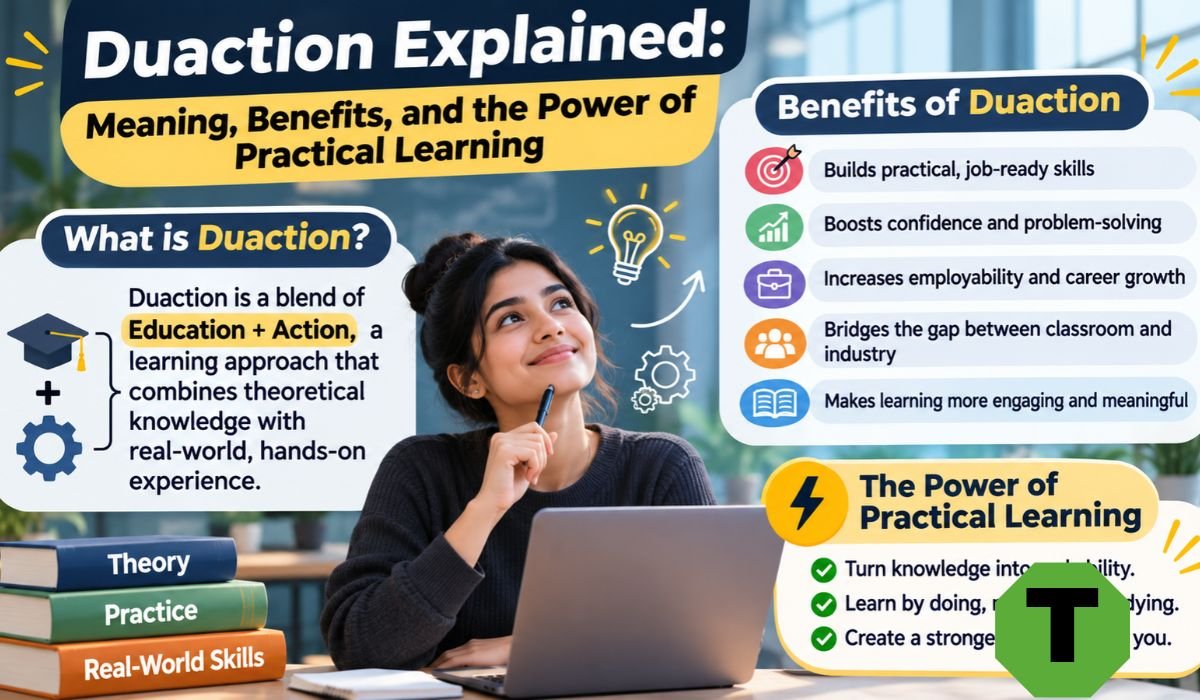
Have you ever spent hours studying something, only to discover that applying it in real life is much harder than expected? Understanding a subject and knowing how to use that knowledge are two very different things. This is where the idea of Duaction becomes particularly interesting.
Duaction describes an approach that brings theoretical knowledge and practical experience together. It encourages people to learn through meaningful activities, reflection, and continuous improvement. In 2026, this concept is especially relevant as changing technologies and workplace demands highlight the importance of practical skills. From classroom education to professional development, combining knowledge with action can make learning more purposeful and rewarding.
What Is Duaction?
Duaction is an informal term used to describe the combination of education and practical action. The central idea is that learning becomes more meaningful when people have opportunities to apply what they understand. For example, someone studying web development can strengthen their understanding by building a functional website rather than simply reading programming books. Although Duaction shares similarities with established educational approaches, including Experiential Learning and Active Learning, it has not been independently established as a distinct academic theory. Its value lies in the educational principles it describes rather than any officially recognized framework, certification, or standardized teaching system.
Quick Information About Duaction
| Information | Details |
|---|---|
| Term | Duaction |
| Meaning | Combining Learning With Practical Action |
| Main Purpose | Developing Applicable Knowledge and Skills |
| Learning Approach | Experience-Based Learning |
| Formal Status | Informal Educational Concept |
| Founder | Not Independently Verified |
| Origin | Not Reliably Established |
| Core Principle | Learning by Doing |
| Primary Audience | Students, Educators, and Professionals |
| Learning Process | Study, Practice, Reflect, and Improve |
| Common Activities | Projects, Exercises, and Simulations |
| Related Methods | Experiential Learning and Active Learning |
| Educational Applications | Schools and Universities |
| Professional Applications | Workplace Training |
| Assessment Methods | Practical Demonstrations and Projects |
| Technology Support | AI and Digital Learning Platforms |
| Main Challenges | Resources, Time, and Accessibility |
| Primary Objective | Real-World Skill Development |
Core Principles of Duaction
The foundation of Duaction rests on connecting ideas with meaningful experiences. Rather than treating education as the simple transfer of information, this perspective encourages learners to participate, ask questions, and examine the results of their decisions. Reflection is particularly important because completing an activity does not automatically mean someone has understood it. Learners need opportunities to recognize their mistakes, consider different approaches, and make improvements. Clear goals, constructive feedback, and appropriate guidance help support this process. Together, these principles encourage people to become more responsible for their learning while gradually developing the ability to work independently.
How Does Duaction Work?
The Duaction learning process typically begins with developing a basic understanding of a subject, followed by a relevant practical activity. Imagine a photography student learning about lighting, shutter speed, and camera settings. After studying these concepts, the student takes photographs under different conditions and examines the results. Feedback from an instructor helps identify weaknesses, while another practice session provides an opportunity to improve. This ongoing relationship between instruction, application, evaluation, and reflection helps transform information into usable knowledge. The process can become more challenging as learners gain experience, allowing them to apply familiar concepts in increasingly unfamiliar situations.
Key Features of Duaction
One of the most useful features of Duaction is its flexibility. Practical learning does not necessarily require expensive equipment, advanced technology, or complicated educational programs. A classroom discussion, simple experiment, collaborative assignment, or realistic workplace scenario can provide valuable experience. Another important feature is learner participation, where individuals actively engage with information instead of relying entirely on passive instruction. Performance-based assessment and constructive feedback also help learners understand their progress. What matters most is whether an activity supports a specific educational objective and encourages meaningful thinking rather than simply keeping participants occupied.
Why Duaction Matters in Modern Education
Modern education must prepare students to understand information and apply it responsibly. Knowing scientific principles, mathematical formulas, or business theories is valuable, but learners also need opportunities to use that knowledge. Research supports the broader importance of active participation. A 2014 study published in the Proceedings of the National Academy of Sciences examined 225 studies involving undergraduate science, technology, engineering, and mathematics courses and found improved academic performance associated with Active Learning. These findings support thoughtfully designed participatory education, although they should not be interpreted as direct evidence validating Duaction as an independent educational method.
pmc.ncbi.nlm.nih.gov
Major Benefits of Duaction
Practical learning can help people develop a stronger understanding of concepts by revealing weaknesses that might remain unnoticed during traditional study. Working through realistic challenges may also strengthen problem-solving abilities, decision-making, communication, and confidence. For professionals, completed projects can provide evidence of skills that qualifications alone may not fully demonstrate. Constructive feedback makes these experiences more valuable by helping learners identify specific improvements. However, the benefits associated with Duaction depend on instructional quality, preparation, task difficulty, and individual circumstances. Practical experience can support academic achievement and career readiness, but it does not guarantee either outcome.
Real-World Examples of Duaction
Examples of Duaction-style learning can be found across many industries. A Digital Marketing student might conduct an SEO audit on a practice website to understand how search optimization works. An engineering student could develop and test a prototype after studying design principles. In healthcare education, supervised clinical simulations allow trainees to rehearse procedures in suitable learning environments. Business students may create marketing campaigns, while language learners improve their abilities through realistic conversations. Even ordinary activities, such as cooking or photography, can demonstrate the relationship between understanding and practical action when learners review their experiences and make thoughtful adjustments.
Where Can Duaction Be Applied?
The principles associated with Duaction can be incorporated into schools, universities, workplaces, online courses, and vocational training programs. Schools can use experiments and research assignments, while universities offer laboratory activities, fieldwork, and supervised placements. Employers may combine training materials with realistic workplace scenarios to help new employees understand their responsibilities. Vocational education is particularly relevant because it often combines occupation-specific knowledge with practical experience, including apprenticeships and workplace training. The appropriate learning environment depends on the subject, available resources, and level of supervision required.
OECD
Duaction vs. Traditional Learning
Duaction places particular emphasis on applying knowledge, while theory-focused teaching generally prioritizes explanations, reading, and conceptual understanding. However, these approaches should not be viewed as opposing educational systems. Traditional Learning provides essential background knowledge that helps people understand why certain processes work. Practical activities then allow learners to explore that information in realistic circumstances. For instance, an instructor may explain mathematical principles before students apply them to a budgeting exercise. Combining both approaches can create a balanced educational experience, particularly when the amount of guidance matches the learner’s existing knowledge and abilities.
Duaction and Established Learning Methods
Duaction shares common ground with Experiential Learning, Active Learning, Project-Based Learning, and Work-Integrated Learning. Educational researcher David A. Kolb published an influential Experiential Learning framework in 1984, describing a cycle involving experience, thoughtful review, developing concepts, and testing new ideas. These established methods provide a stronger academic foundation for understanding the benefits of practical experience. Their similarities with Duaction are useful, but they do not establish the term as a new educational theory. Recognizing this distinction helps students and educators make informed decisions based on genuine educational research rather than unfamiliar terminology.
Toronto Metropolitan University (TMU)
How to Implement Duaction Effectively
Successfully applying Duaction-style learning begins with identifying what someone should understand or be able to demonstrate. Educators can introduce essential information before selecting a practical activity that matches the intended outcome. Beginners generally benefit from demonstrations and structured guidance, while experienced learners may be ready for more independent assignments. After completing the activity, participants should receive specific feedback and have an opportunity to apply it during another attempt. Clear expectations, accessible resources, and realistic assessment criteria make practical learning more effective. Even a small, well-designed exercise can provide greater educational value than a complicated project without a clear purpose.
The Role of Technology in Duaction
In 2026, technology provides additional opportunities to combine learning with practical experience. Digital simulations, interactive platforms, virtual laboratories, and Artificial Intelligence can support guided exercises in classrooms and online courses. AI tools may generate practice scenarios, provide preliminary feedback, and help learners explore unfamiliar concepts. However, inaccurate information and excessive dependence on automated assistance can interfere with genuine understanding. UNESCO’s guidance on generative AI emphasizes human-centered education, data privacy, and appropriate safeguards. Technology should support independent thinking and practical skill development rather than replace them.
UNESCO
Challenges and Limitations of Duaction
Despite its potential advantages, practical learning presents several challenges. Developing meaningful activities requires preparation, suitable resources, and sometimes specialist equipment. Large classes can make individual feedback difficult, while unequal access to technology may limit participation. Some activities require qualified supervision because mistakes could create safety risks. Assessment can also become complicated when several skills contribute to a single project. Educators can address these limitations by using manageable assignments, providing accessible alternatives, and setting clear performance standards. Duaction-style learning works best when practical experiences are carefully designed around learners’ needs rather than introduced simply because they appear innovative.
How to Measure the Success of Duaction
The effectiveness of practical learning should be measured by genuine improvement rather than the number of completed activities. Educators can compare initial and later performance, examine project portfolios, and evaluate how learners explain their decisions. A particularly useful measure is whether someone can apply familiar knowledge to a new problem without relying entirely on previous instructions. Self-reflection also helps learners recognize which strategies are working and which require adjustment. Research summarized by the Education Endowment Foundation supports teaching learners to plan, monitor, and evaluate their own learning, reinforcing the importance of thoughtful reflection.
EEF
The Future of Duaction
As workplaces and educational environments continue to change, practical skill development and lifelong learning are likely to remain important. AI-assisted education, interactive simulations, hybrid learning, and collaborations between employers and educational institutions may create new opportunities for learners to gain relevant experience. However, the future of practical education depends on more than technological innovation. Accessibility, teaching quality, reliable information, and meaningful assessment remain essential. Whether Duaction becomes a widely recognized educational term is uncertain, but the relationship between knowledge, experience, and reflection will continue to offer valuable opportunities for personal and professional growth.
Final Thoughts
Duaction highlights an important lesson about education: knowledge becomes more useful when people understand how to apply it. Its emphasis on practical experience, meaningful participation, and continuous improvement offers a helpful perspective for students, educators, and professionals.
Rather than replacing established teaching methods, Duaction is best understood as an informal concept that reflects familiar educational principles. By combining reliable instruction with purposeful activities, constructive feedback, and reflection, learners can develop abilities that extend beyond the classroom and support them throughout their lives.
FAQs About Duaction
What Does Duaction Mean?
Duaction describes the combination of theoretical learning and practical action. Its primary purpose is to help people develop knowledge and apply that understanding through meaningful experiences, exercises, projects, and reflection.
Is Duaction a Recognized Educational Theory?
Duaction has not been independently established as a recognized educational theory. It shares similarities with established approaches such as Experiential Learning, Active Learning, and Project-Based Learning.
How Does Duaction Improve Learning?
Duaction-style activities allow learners to test their understanding, recognize mistakes, and receive constructive feedback. When appropriately designed, these experiences can strengthen knowledge and support independent problem-solving.
Can Duaction Be Used in Online Education?
Yes. Online courses can incorporate practical learning through interactive assignments, virtual simulations, collaborative projects, and digital exercises. Clear instructions and meaningful feedback remain important for successful learning.
How Does Duaction Support Career Development?
Practical learning helps professionals develop and demonstrate job-related abilities through projects, supervised assignments, and workplace experiences. These opportunities may improve career readiness, although employment outcomes depend on several factors.
What Is the Difference Between Duaction and Experiential Learning?
Experiential Learning is an established educational approach supported by published academic literature. Duaction is an informal descriptive term that emphasizes similar connections between knowledge, practical action, and reflection.
What Are the Main Challenges of Duaction?
Common challenges include limited resources, preparation time, accessibility concerns, supervision requirements, and practical assessment difficulties. Careful planning and suitable learning activities can help address these limitations.
Is Duaction Useful for Beginners?
Yes. Beginners can benefit from practical learning when activities are appropriate for their experience, supported by clear instructions, and accompanied by helpful feedback. Simple tasks provide a useful foundation for gradually developing more advanced skills.
Learn more and explore exciting content on: Hyperfixation Explained: Meaning, Signs, Causes, and How to Manage It
[…] Learn more and explore exciting content on: Duaction Explained: Meaning, Benefits, and the Power of Practical Learning […]