
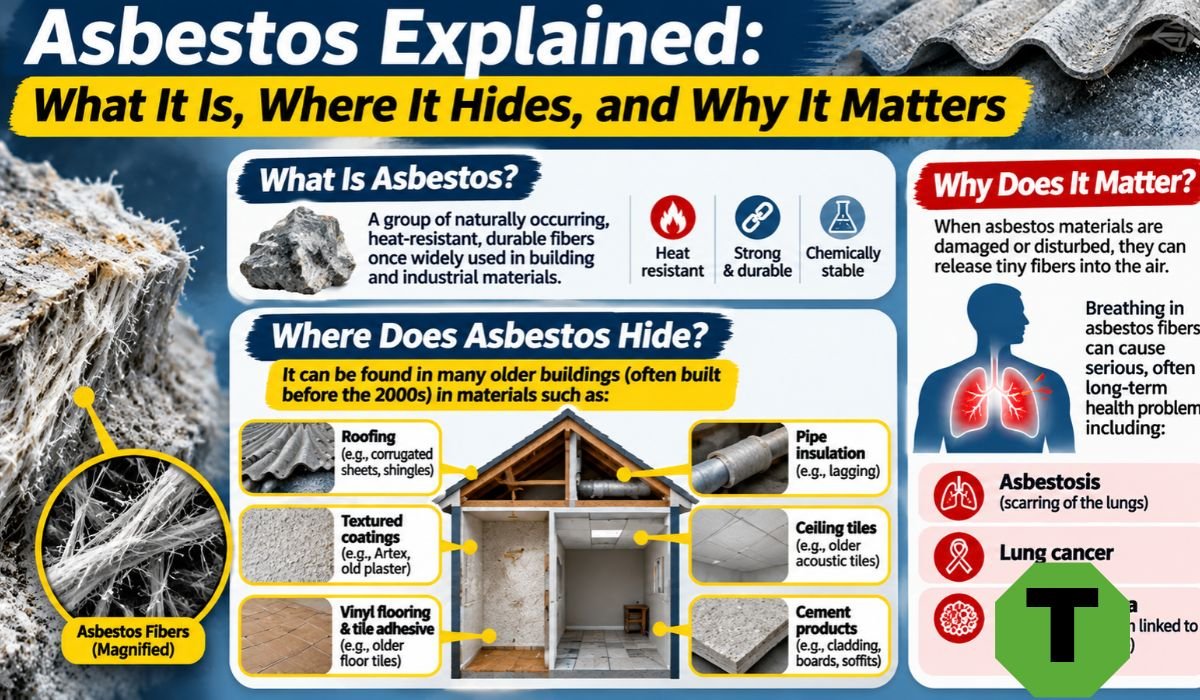
Imagine renovating an old house, removing outdated ceiling tiles, or replacing damaged insulation without realizing that the materials contain something potentially dangerous. For decades, Asbestos was considered a valuable material because of its strength, affordability, and remarkable resistance to heat. It was widely used in homes, factories, schools, and industrial equipment.
Today, scientists recognize asbestos as a serious health hazard linked to several life-threatening diseases. Although many countries have prohibited its use, older buildings and industrial products continue to present exposure risks in 2026.
Understanding what asbestos is, where it may be found, and how to manage it responsibly can help protect individuals, families, and entire communities.
Quick Bio Information About Asbestos
| Information | Details |
|---|---|
| Name | Asbestos |
| Classification | Fibrous Silicate Minerals |
| Origin | Naturally Occurring Rocks |
| Number of Types | Six |
| Mineral Families | Serpentine and Amphibole |
| Common Colors | White, Brown, Blue, Gray and Green |
| Most Commercially Used Type | Chrysotile |
| Historical Use | More Than 4,000 Years |
| Commercial Expansion | Late 19th Century |
| Main Properties | Strength and Heat Resistance |
| Common Applications | Roofing, Insulation and Cement |
| Primary Exposure Route | Inhalation |
| Carcinogenic Status | Known Human Carcinogen |
| Major Associated Diseases | Mesothelioma, Lung Cancer and Asbestosis |
| Disease Latency Period | 10–40 Years or Longer |
| Global Production in 2025 | Approximately 960,000 Metric Tonnes |
| Identification Method | Professional Laboratory Testing |
| Recommended Management | Qualified Professional Assessment |
What Is Asbestos?
Asbestos refers to six naturally occurring minerals that develop long, thin fibers. These fibers are exceptionally strong and resistant to heat, making them historically valuable for construction and manufacturing. Unlike ordinary building materials, asbestos contains microscopic fibers that can become airborne when disturbed.
Natural asbestos deposits occur within certain rock formations around the world. Although larger mineral samples may have a visibly fibrous appearance, individual airborne fibers are generally too small to see without specialized equipment. The greatest concern arises when people inhale these fibers. Their durability allows some fibers to remain inside the body for extended periods, potentially contributing to serious health complications.
ATSDR
History and Origin of Asbestos
The history of asbestos stretches back thousands of years. Archaeological discoveries suggest that ancient communities in Finland incorporated asbestos minerals into pottery to improve its durability. Historical accounts also describe its use in fire-resistant fabrics and lamp wicks.
The term asbestos comes from an ancient Greek word associated with something that cannot easily be extinguished. During the Industrial Revolution, commercial interest increased significantly as manufacturers discovered its practical advantages.
By the 20th century, asbestos had become a common component of buildings, machinery, and consumer products. However, mounting scientific evidence connecting occupational exposure with serious diseases eventually transformed this once-celebrated mineral into a major public health concern.
Six Different Types of Asbestos
Asbestos is divided into two mineral families known as Serpentine and Amphibole. Chrysotile, commonly called White Asbestos, belongs to the Serpentine family and historically accounted for most commercial use. Its fibers are generally curved and flexible.
The Amphibole family includes Amosite, Crocidolite, Tremolite, Actinolite, and Anthophyllite. These minerals typically have straighter fibers.
| Asbestos Type | Common Historical Uses |
|---|---|
| Chrysotile | Roofing and Cement Products |
| Amosite | Thermal Insulation |
| Crocidolite | Industrial and Pipe Insulation |
| Tremolite | Certain Insulating Products and Mineral Contaminants |
| Actinolite | Certain Building Materials and Mineral Contaminants |
| Anthophyllite | Insulation and Other Specialized Products |
Although their properties differ, all six forms can cause cancer. No asbestos type should be considered harmless.
ATSDR
Why Was Asbestos So Popular?
The popularity of asbestos was largely connected to its unusual physical properties. It provided effective thermal insulation, resisted fire, and remained durable under demanding industrial conditions. Manufacturers could combine its fibers with cement, fabrics, and other materials to create strong products.
Asbestos was also relatively affordable, making it attractive for large construction projects. Builders used it to improve fire protection, while industrial companies relied on it to insulate machinery operating at high temperatures. Unfortunately, its commercial advantages encouraged widespread use long before its health consequences were fully understood. Many of those historical products remain in service today.
Common Uses of Asbestos
Throughout the 20th century, asbestos appeared in an impressive range of products. Construction companies incorporated it into cement sheets, roofing materials, floor tiles, ceiling panels, and insulating boards. Manufacturers also used asbestos in boilers, furnaces, industrial gaskets, electrical insulation, and protective fabrics.
The automotive industry historically relied on asbestos in certain brake and clutch components because friction generates considerable heat. Ships, power stations, and factories also used asbestos-based insulation extensively.
These applications explain why managing historical asbestos remains a complicated challenge. Even when new products no longer contain it, older equipment and infrastructure may still require careful handling.
Where Does Asbestos Hide in Buildings?
Asbestos-containing materials can remain hidden inside residential and commercial properties for decades. Common locations include old pipe insulation, textured ceilings, flooring adhesives, attic insulation, cement siding, roofing sheets, and materials surrounding heating equipment.
Schools, hospitals, warehouses, and factories may also contain asbestos-based fireproofing or insulation installed during earlier construction projects. Some materials are concealed behind walls or beneath newer flooring.
However, the age of a property does not automatically confirm whether asbestos is present. Construction practices and regulations vary between countries. A qualified asbestos inspection is particularly valuable before undertaking renovations that could disturb suspicious building materials.
epa.gov
Why Is Asbestos Dangerous?
Asbestos becomes particularly hazardous when materials containing it are damaged, disturbed, or deteriorating. Activities such as drilling, sanding, cutting, and demolition can release tiny mineral fibers into the surrounding air.
Once inhaled, certain fibers may become trapped within lung tissue, contributing to inflammation and permanent damage. Health complications generally develop gradually rather than immediately.
Intact asbestos-containing materials that remain undisturbed typically present a lower exposure risk. However, this does not mean they are completely harmless. Their condition and potential for future disturbance must be considered when deciding how they should be managed.
Health Risks and Diseases
Mesothelioma is one of the most serious diseases associated with asbestos exposure. This relatively rare cancer develops in tissue lining internal organs, most commonly around the lungs.
Another major condition is Asbestosis, a chronic disease involving permanent lung scarring that makes breathing increasingly difficult. Exposure also increases the likelihood of lung cancer, particularly among individuals who smoke tobacco.
Other recognized complications include pleural thickening, pleural plaques, cancer of the larynx, and ovarian cancer. These conditions demonstrate why asbestos exposure is treated as a significant medical and occupational safety concern.
ATSDR
Symptoms of Asbestos Exposure
Asbestos-related diseases often develop silently over many years. Potential symptoms include persistent coughing, chest discomfort, breathing difficulties, unexplained weight loss, and ongoing tiredness.
Unfortunately, these symptoms can resemble those associated with numerous other medical conditions. According to the National Cancer Institute, asbestos-related health problems may become apparent 10 to 40 years or longer following exposure.
Anyone concerned about previous asbestos exposure should discuss their occupational, residential, and medical history with a healthcare professional. An appropriate examination may involve lung function testing, imaging, or specialist assessment. Symptoms alone cannot establish an asbestos-related diagnosis.
NCI
Who Is Most at Risk?
People working in construction, demolition, mining, plumbing, electrical installation, and industrial maintenance may encounter asbestos-containing materials more frequently than the general population.
Historically, workers sometimes carried contaminated dust home on their clothing and equipment, creating secondary exposure risks for family members.
Homeowners undertaking renovations without professional inspections may also disturb previously concealed asbestos. Additionally, communities near certain mining operations or contaminated industrial locations can experience environmental exposure. Earthquakes, fires, and other disasters that damage older buildings create another important concern for emergency workers and local residents.
How to Identify Asbestos Safely
Identifying asbestos through appearance alone is unreliable because many asbestos-containing products resemble ordinary materials. Color, texture, and age cannot establish whether a product contains asbestos.
Professional asbestos testing involves collecting representative samples under appropriate safety procedures and submitting them for laboratory analysis. Homeowners should not attempt to collect samples themselves.
Before purchasing, renovating, or demolishing an older property, an asbestos survey may help identify hidden hazards and guide future decisions. Maintaining a record of confirmed asbestos locations can also protect contractors, maintenance workers, and future property owners.
What to Do If You Find Asbestos
Discovering suspected asbestos does not automatically mean immediate removal is necessary. If renovation work is underway, stop the activity, avoid further disturbance, and restrict access to the affected area.
Do not attempt to remove suspicious insulation, break cement sheets, or clean potentially contaminated debris using household vacuum cleaners. Ordinary cleaning methods can spread dangerous fibers.
The Environmental Protection Agency recommends leaving undamaged materials alone and obtaining qualified professional assistance when suspicious materials are damaged or likely to be disturbed. A professional assessment can determine the most appropriate management approach.
epa.gov
Asbestos Removal and Management
Professional asbestos removal requires careful planning, specialized equipment, trained personnel, and appropriate waste disposal procedures. Depending on the material’s condition, specialists may recommend removal, encapsulation, enclosure, or ongoing monitoring.
Encapsulation involves professionally sealing suitable materials to reduce fiber release. Enclosure involves installing a protective barrier around asbestos-containing materials.
Removal costs depend on the quantity of material, accessibility, property size, condition, and applicable local requirements. Because improper handling may create additional contamination, asbestos removal should never be treated as a routine home improvement task.
Global Asbestos Statistics in 2026
Asbestos remains an international public health challenge. The World Health Organization and International Labour Organization estimate that workplace exposure contributes to more than 200,000 deaths annually worldwide, based on 2016 estimates. More than 50 WHO member states have prohibited asbestos use.
who.int
However, global mining continues. According to the U.S. Geological Survey’s 2026 Mineral Commodity Summaries, worldwide asbestos production reached an estimated 960,000 metric tonnes in 2025, with consumption of approximately 930,000 metric tonnes.
Russia, China, Kazakhstan, and Brazil remain major producers. These figures demonstrate that asbestos is not simply a historical problem.
pubs.usgs.gov
Safer Alternatives and Exposure Prevention
Modern manufacturing offers numerous alternatives to asbestos, including cellulose insulation, calcium silicate, mineral wool, glass fibers, and asbestos-free fiber cement. Each replacement should be evaluated for its intended application and potential health hazards.
Preventing asbestos exposure depends on responsible property maintenance, professional inspections, workplace training, and effective safety procedures. Employers should assess exposure risks before construction or maintenance activities begin.
Even projects intended to improve energy efficiency, such as replacing old insulation, may disturb historical asbestos-containing materials. Planning these improvements carefully helps ensure that modern upgrades do not create unexpected health hazards.
FAQs About Asbestos
What Is Asbestos in Simple Words?
Asbestos is a group of natural minerals containing extremely thin and durable fibers. It was historically used in construction and manufacturing because of its heat resistance, but breathing its fibers can cause serious diseases.
Is All Asbestos Dangerous?
Yes. All six recognized asbestos types can cause cancer. Although their physical properties and associated risks differ, none should be considered safe to inhale.
Can One Exposure to Asbestos Be Harmful?
A single exposure may contribute to long-term health risks, although the likelihood of disease generally increases with the amount and duration of exposure. Exposure does not automatically mean someone will develop an illness.
What Does Asbestos Look Like?
Natural asbestos may appear white, blue, brown, gray, or green and have a fibrous texture. However, asbestos-containing building materials cannot be reliably identified by appearance alone. Professional laboratory testing is necessary.
Is Asbestos Still Used in 2026?
Yes. Although numerous countries have introduced bans and restrictions, asbestos mining and commercial use continue in certain regions, particularly for construction products.
Can You Remove Asbestos Yourself?
DIY asbestos removal is not recommended. Disturbing asbestos-containing materials without appropriate training and safety controls can release hazardous fibers. Qualified professionals can determine the safest management method.
How Long Does Asbestos Take to Cause Illness?
Asbestos-related diseases can develop decades after exposure. The latency period varies depending on the disease, exposure history, and individual health factors. Some conditions may take 40 years or longer to become apparent.
Is Asbestos Dangerous if Left Undisturbed?
Materials containing asbestos that remain intact and undisturbed generally present a lower risk of exposure. Nevertheless, their condition should be assessed before renovation, demolition, or maintenance activities.
Final Thoughts
Asbestos is a powerful example of how a seemingly useful invention of industrial development can create lasting public health challenges. Its strength and heat resistance made it historically valuable, but its microscopic fibers have caused serious suffering worldwide.
In 2026, understanding asbestos remains essential for homeowners, construction workers, employers, and property managers. Recognizing potential hazards, avoiding unnecessary disturbance, and relying on qualified professionals are important steps toward preventing exposure.
Ultimately, greater awareness, responsible building management, and the adoption of safer materials can help protect both present and future generations from preventable asbestos-related diseases.
Learn more and explore exciting content on: Printer Guide: Everything You Need to Know About Types, Features, and Uses
[…] Learn more and explore exciting content on: Asbestos Explained: What It Is, Where It Hides, and Why It Matters […]